Can Hypothyroidism predispose you to SIBO?
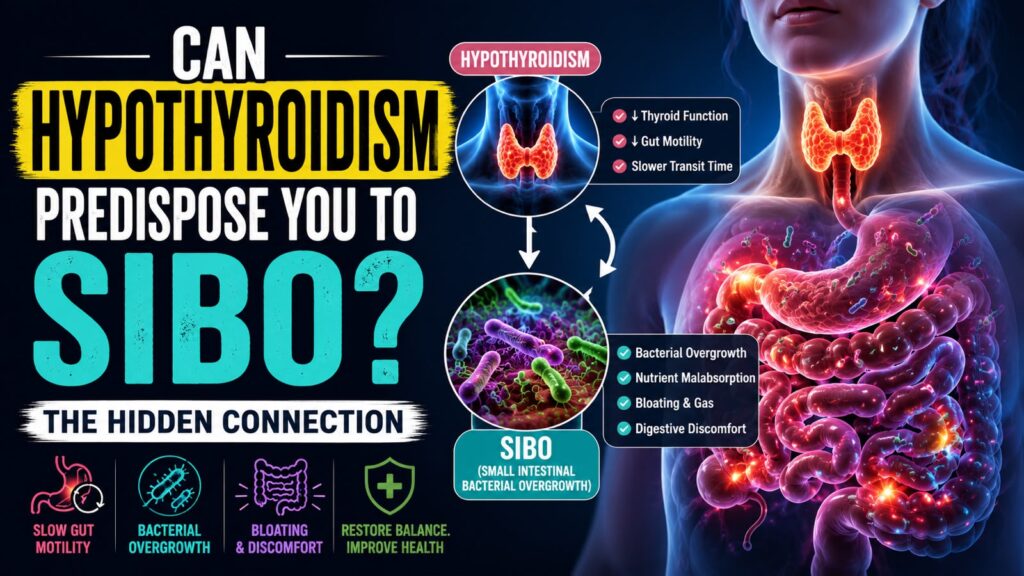
Can Hypothyroidism predispose you to SIBO? How Hypothyroidism Contributes to SIBO? (SIBO in Hypothyroidism) It has been reported that SIBO may be present in more than half of the patients with hypothyroidism (5). Recent studies suggest that small intestinal bacterial overgrowth (SIBO), a disorder of excessive bacteria in the small bowel, may also be associated with hypothyroidism (6-8). Some studies have suggested that hypothyroidism results in decreased gut motility, which increases the risk for the development of SIBO (1,3). The objective of this article is to understand the association between hypothyroidism, altered GI motility and development of SIBO. Small intestinal bacterial overgrowth (SIBO) is defined as an abnormally high bacterial population level in the small intestine. SIBO occurs when mechanisms controlling enteric bacterial growth are disturbed. In SIBO, bacteria such as Gram-negative coliforms overgrow in the small intestine, leading to gastrointestinal symptoms such as abdominal pain, bloating, and gas (12,13). One of the most common mechanisms that lead to SIBO is the small intestinal dysmotility. Thus, small intestinal dysmotility constitutes one of the risk factors for development of SIBO (9,10,11). Other risk factors include failure of the gastric acid barrier, anatomic alterations or impaired immunity (10). On the other hand, Hypothyroidism is one of the most common endocrine conditions globally (14-16). Hypothyroidism can affect multiple organ systems, resulting in symptoms associated with decreased quality of life, including fatigue, weakness, memory issues, hair loss, hypersensitivity to cold, dry skin, and depression (17,18). Hypothyroidism is known to affect the entire gastrointestinal system and cause hypomotility (19-21). A reduction in the motor activity of stomach, small intestine, and colon has been reported in previous studies. It has been found that hypothyroid patients show significant reduction in gastric emptying and thus have a delayed intestinal transit time (19-22). Changes in the motor activity of the digestive system may result in gastric or abdominal distension and constipation in hypothyroidism (20,23). Clinically, constipation and abdominal distension are known to be the typical gastrointestinal (GI) symptoms of SIBO as well. Thus, intestinal motor dysfunction associated with hypothyroidism could predispose you to bacterial overgrowth. Study references: A study done by Olga et al. reported that Hypothyroidism prominently reduces esophageal and gastric motor activity and can cause gastrointestinal dysfunction. The study group included 30 females with primary hypothyroidism and 10 healthy females. They used – Gastroesophageal scintigraphy method, which is a noninvasive, simple, physiological method to use for evaluating esophagogastric motility and can be helpful in selecting treatment regimens for hypothyroidism (3). Another study by Wei et al. evaluated the incidence and risks of subsequently developing SIBO, and changes in small bowel microbial populations, in subjects with hypothyroidism or autoimmune thyroiditis (2). The findings from this study suggest that there is an increased risk of subsequent development of SIBO in individuals with hypothyroidism, and that this risk is increased in individuals with autoimmune thyroiditis. Moreover, the overgrowth of specific Gram-negative coliforms may be involved, as greater prevalences of Klebsiella species and lesser prevalence of Escherichia/Shigella are seen in the core duodenal microbiome of individuals with hypothyroidism and SIBO as compared to individuals with SIBO alone (2). How Gut Dysbiosis contribute to Hypothyroidism? (Hypothyroidism in SIBO) Recent studies indicate that gut microbial dysbiosis may influence the onset and progression of hypothyroidism through mechanisms involving immune dysregulation, increased intestinal permeability, chronic low-grade inflammation, and impaired nutrient absorption. Also, microbial metabolites such as short-chain fatty acids and bile acids are increasingly recognized as modulators of thyroid hormone metabolism, tissue sensitivity, and enterohepatic circulation (4). Additionally, Microbiota influence the uptake of minerals relevant to the thyroid gland including iodine, selenium, zinc, and iron. All of them play a role in supporting thyroid function and there is a clear link between thyroid dysfunction and altered levels of these minerals (4). Iodine, iron, and copper are crucial for thyroid hormone synthesis, selenium and zinc are needed for converting T4 to T3, and vitamin D assists in regulating the immune response. Those micronutrients are often found to be deficient in autoimmune thyroid diseases (AITDs), resulting in malfunctioning of the thyroid. (4) The inflammatory regulation of an impaired microbiota and their negative influence on the immune system seems to be likely to promote autoimmune diseases such as autoimmune thyroid diseases (AITD) (24). Hashimoto’s thyroiditis (HT) is the most common thyroid disorder worldwide with a general prevalence of around 10–12% and is characterized by chronic inflammation, leading to hypothyroidism, and often, destruction of the thyroid gland (25,26). Graves’ disease (GD) is another AITD which has a prevalence of 1–1.5%. It has been proposed that the interaction of genetic predisposition, immune impairment, and environmental factors (i.e. micronutrients, gut microbiota) play an important role in the pathogenesis of these diseases. (4) Furthermore, intestinal bacteria play a key role in vitamin synthesis (such as vitamin K, folic acid, vitamin B2, B3, B5, B6, B7, and B12 (27,28) digestion of dietary fibers, regulation of the immune response, and mental disorders (4). Heme iron Fe2+, is an important source for both the human and the intestinal microbiota. Studies have reported that iron is essential for bacterial growth and iron availability influences the composition of the microbiota because some bacteria have developed better heme-catching mechanisms. On the other hand, microbiota can increase iron bioavailability in the colon through lowering of pH via the production of short chain fatty acids (4). Some Bacteria can make siderophores (such as enterobactin) which are high-affinity proteins for iron that acquire Fe3+ (dietary non-heme iron), especially in iron-poor environments. These are chelators that pull iron away from insoluble compounds and move it into a form that bacteria can take up. Humans developed a defense protein called lipocalin-2 to sequester siderophores and limit microbial growth (24,29,30). Pathogenic strains particularly grow well in heme-rich conditions, due to their efficient heme capturing ability (29). Many enteric gram-negative bacteria, including Salmonella, Shigella, and pathogenic E. coli require iron for their virulence and colonization (31,32). On the other hand, Beneficial commensal gut bacteria from genera Lactobacillus and Bifidobacterium require less or no iron (33). In mice, Constante et al. demonstrated that a heme-rich diet decreases microbial diversity