
July 26, 2026

Blog

THE KAPHA BODY TYPE

THE KAPHA BODY TYPE According to Ayurveda, each one of us are born with a certain body type or constitution known as Prakruti. When we deviate from our natural constitution (due to stress, unhealthy diet, poor lifestyle, medicines etc.), we attract diseases. The diseased state or an imbalance in our energies is known as Dosha or Vikruti.   In Ayurveda there are 3 types of Doshas or body types – Vata, Pitta and Kapha. In this article we are going to discuss the Kapha Dosha! Our body is made up of 5 elements air, water, earth, fire and ether.  The Kapha dosha – is principally a combination of Earth and Water elements. It is the energy that forms the body’s structure and provides the “glue” or cohesion that holds the cells together, lubricates joints, moisturizes the skin and maintains immunity. It governs the growth of the dhatus (bodily tissues) – the blood, fat, muscles, bones, marrow and other fluids in the body. It is also responsible for healing. The qualities of Kapha dosha are – moist, cold, heavy, slow/dull, soft, sticky or cloudy, oily, liquid, slimy/smooth, dense and static. In Ayurveda, there is a law which states that “like increases like and opposites decrease.” When similar qualities come together, their quantitative expression increases. For example, Winter season has attributes of liquid, heavy, cold, sticky and cloudy. Therefore, in the winter, when these characteristics predominate in the external environment, internal kapha tends to be increased.  Physiologically, kapha moistens food, gives bulk to our tissues, lubricates joints, stores energy, and relates to cool bodily fluids such as water, mucous, and lymph. Psychologically, when in balance – Kapha is expressed as love, calmness, and forgiveness. When out of balance – it leads to attachment, greed, possessiveness, and congestion disorders. The main seat of kapha in the body is stomach and chest. It is also located in throat, lungs, head, lymph, fatty tissue, connective tissue, ligaments, and tendons. Why the “Seat” Matters? Understanding the seat of a dosha helps in its treatment. The Chest connection: Since Kapha sits in the chest, breathing exercises (Pranayama) and heart-opening yoga poses are the fastest ways to “stir” and clear excess Kapha. The Digestive connection: Even though it sits in the chest, Kapha accumulates in the stomach first. This is why a “sluggish stomach” is often the first sign of a Kapha imbalance before it moves up into the lungs as congestion. Common Kapha Disorders of the Body Obesity, Diabetes, Colds and Flu, Yeast conditions, Sinus congestion, Anorexia and bulimia, lymphatic system disorders, excessive sleeping, water retention/bloating, allergies, excess phlegm and mucous conditions, intolerance of cold and damp, asthma, low thyroid function, heart disease. Characteristics of the Kapha Individual The phrase Kapha comes from two Sanskrit roots, ‘ka’ meaning water and ‘pha’ meaning to flourish – that which is flourished by water. Kapha’s nature is also Earth, so Earth and Water give kapha individual its definitive qualities. Qualities received by kapha from earth include heaviness and stability, and from water include oiliness and smoothness. Therefore, Kapha molecules tend to stick together to form dense masses (earth element) and give the body a chubby shape.  Physiological Characteristics of Kapha person (The Kapha Body) Because Kapha is naturally heavy, slow, and cool, its physiological traits reflect a “solid” and “enduring” nature. Physical Build & Structure Frame: Generally broad-shouldered with a sturdy, “large-boned” skeletal structure. Kapha types are naturally strong and have the highest physical endurance of all three doshas. Weight: A natural tendency to gain weight easily and a significant challenge in losing it. This is due to a slower basal metabolic rate. Joints: Well-lubricated, large, and hidden (not prominent or “knobby” like Vata). They rarely suffer from “popping” joints but may experience fluid retention or stiffness. Skin, Hair, and Nails Skin: Typically thick, pale, and cool to the touch. It is naturally oily and well-hydrated, which often leads to fewer wrinkles and a more youthful appearance as they age. Hair: Thick, voluminous, and often wavy or curly. It tends to be lustrous and strong, though it can become oily if Kapha is imbalanced. Eyes: Large, attractive, and “liquid” or soft in appearance. They usually have thick, long eyelashes and clear, white sclera (the whites of the eyes). Digestion and Metabolism Appetite: Regular but slow. Kapha types can often skip a meal without feeling irritable (unlike Pittas), as their bodies are excellent at storing energy. Metabolism (Agni): Known as Mandagni (slow/dull fire). Digestion takes a long time, and they may feel heavy or sleepy immediately after eating. Elimination: Bowel movements are usually regular, soft, and oily. Sleep and Energy Levels Sleep: Deep, heavy, and long. Kaphas are the “heavy sleepers” of the world and often find it very difficult to wake up in the morning. Stamina: While they are slow to start (inertia), they have incredible long-term stamina. They can work or exercise for long periods once they get moving. Pulse: The Kapha pulse is described as “Swan-like” (Gaja Gamini). it is slow, steady, and regular. Feature Characteristic Complexion Pale, fair, uniform Body Temp Cool and slightly damp (clammy hands) Voice Deep, pleasant, and resonant Immunity Naturally strong; best resistance to disease Tendencies Excess mucus, congestion, and water retention Psychological Characteristics of Kapha person (The Kapha Mind) Qualities of Balanced Kapha Individuals Loving, Compassionate, Patient, Sweet, Forgiving, Gentle, Emotionally Stable, Inherent Desire to Help Others, Calm, Loyal, Nurturing, Accepting of Others, Strong Stamina and Endurance, Romantic, Sensual, endowed with excellent long-term memory, long term thinking and planning, good listeners, deeply satisfied with life and good natured Qualities of Imbalanced Kapha Individuals Greedy, unchanging – rigid, Hoard material things, Unable to say No, Easily attached to people and things, Easily taken advantage of, Possessive, Take on other people’s problems, fearful of letting go, overly passive, lethargic, Unable to express thoughts and emotion, envious, give up easily, slow to understand/grasp things, depressed for long periods of time, introverted, complacent, living life on the surface Kapha dreams – One of the important functions
Blog

THE VATA BODY TYPE

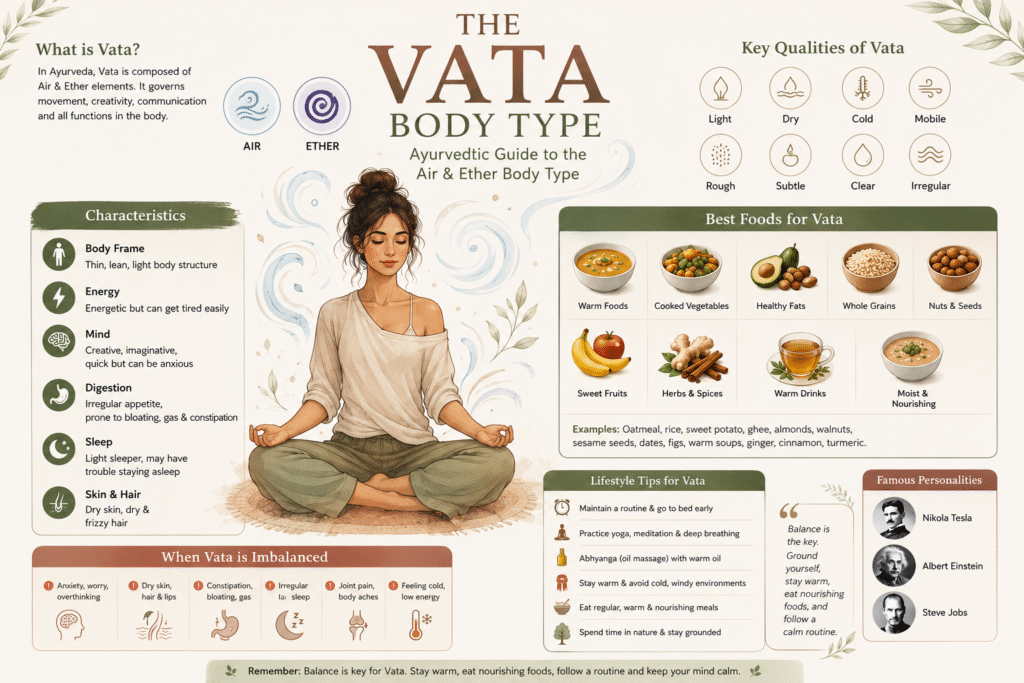
THE VATA BODY TYPE According to Ayurveda, each one of us are born with a certain body constitution known as Prakruti. When we deviate from our natural constitution (due to stress, unhealthy diet, poor lifestyle, medicines etc.), we attract diseases. The diseased state or an imbalance in our energies is known as Dosha or Vikruti.  In Ayurveda there are 3 types of Doshas or Body types – Vata, Pitta and Kapha. In this article we are going to discuss the Vata Dosha! Our body is made up of 5 elements air, water, earth, fire and ether.  Vata dosha – is principally a combination of space and air elements.  The Sanskrit term Vata is related to the verb “vah,” meaning vehicle, to carry or to move which translates as “wind’ or “that which moves things.” So, Vata is the energy of the movement and the force governing all biological activity. It is the principle of mobility that regulates all activity in the body, from how many thoughts one might have during a given period to how efficiently food moves through the intestines. The Vata quality is responsible for joy, happiness, creativity, speech, sneezing, and elimination, to name just a few functions. Vata is often called the “King of the Doshas” since it governs the body’s greater life force – “Prana” and “gives motion to Pitta and Kapha.” Thus, when Vata (Prana) leaves the body, life ceases. The qualities of Vata dosha are – dry, rough, light, mobile, clear, subtle, and cold. A Vata individual will display physical and mental characteristics that reflect these qualities in both balanced and imbalanced state. Physiologically, Vata governs anything related to movement, such as breathing, talking, nerve impulses, movements in the muscles and tissues, circulation, assimilation of food, elimination, urination, and menstruation.  Psychologically, Vata governs communication, creativity, flexibility, and quickness of thought. The main seat of Vata in the body is colon. It is also located in thighs, bones, joints, ears, skin, brain, and nerve tissues.  Why Knowing the “Seat” Matters? Understanding the seat of a dosha helps in its treatment. In Ayurvedic medicine, if you want to calm a restless mind or soothe “windy” joints, you don’t just treat the head or the knees—you treat the colon. This is why: Digestion First: Keeping the colon hydrated and moving (avoiding constipation) is the #1 way to keep Vata balanced. Warmth & Oil: Since Vata’s seats are prone to cold and dryness, applying warm oils (Abhyanga) to the skin and hips is highly effective. Grounding: Focusing on the lower half of the body through grounding exercises helps “descend” the flighty energy of Vata back to its seat. Characteristics of the Vata Individual In Ayurveda, a Vata individual is defined by the elements of Air and Space. Their physiology is characterized by lightness, dryness, coldness, and irregularity. Because Vata governs all movement in the body, a Vata person’s system is often active but easily exhausted. The Vata Paradox: While they are the most energetic and creative of the types, their physiology is the most fragile. They are like a high-performance sports car with a very small fuel tank. Physiological Characteristics of Vata person (The Vata Body) General Build and Frame Structure: Vata types are usually at the extremes—either very tall or very short. They have a naturally thin, slender, or “willowy” frame. Weight: They generally have a low body weight and find it very difficult to gain weight and even harder to keep it on. Their metabolism is fast but erratic. Bone Structure: Because they lack subcutaneous fat, their joints, veins, and tendons are often very prominent or “knobby.” Bones and joints are often prominent or “bony” due to a lack of padding. It is common for their joints to make cracking or popping sounds. Skin, Hair, and Nails Skin: Naturally dry, thin, and cool to the touch. They are the most prone to chapping, cracking, and premature wrinkles. Veins are often visible beneath the surface. Hair: Hair is often thin, frizzy, or curly and prone to being brittle. It tends to be dry and can be prone to split ends.  Nails: Often brittle, thin, and prone to breaking or peeling. Face and Senses Face: Face is often thin and long with small, deep-set, or active eyes. Eyes: Usually small, deep-set, and active (sometimes described as “shifty” or “darting”). They may lack the luster or moisture seen in other types. Teeth: Can be irregular, protruding, or large. Digestion and Metabolism (The “Variable” Nature) Appetite: Highly erratic. They may be ravenous one day and forget to eat the next. Digestion: Prone to “windy” digestive issues such as gas, bloating, and constipation. Their “Agni” (digestive fire) is like a candle in the wind—unstable and easily blown out. Excretion: Bowel movements are often dry, hard, and irregular. Energy and Movement Activity Level: They move quickly and talk fast. However, they have low endurance. They are “sprinters, not marathoners.” They tend to use up their energy in quick bursts and often experience a “crash” after periods of high activity. Sleep: Light and easily disturbed. Vata types are the most likely to suffer from insomnia or wake up feeling unrefreshed between 2:00 AM and 6:00 AM (the Vata time of night). Elimination: The “Seat of Vata” (the colon) tends toward dryness, making constipation a common physiological trait. Feature Characteristic Body Weight Low; difficult to gain weight Skin Texture Dry, rough, cool Joints Prominent; prone to cracking Hands/Feet Usually cold (poor circulation) Speech Fast, talkative, sometimes scattered Weather Preference Loves the sun; hates cold and wind Psychological Characteristics of Vata person (The Vata Mind) In balance – Vata individuals are dynamic, just like the wind at their foundation. These individuals experience life “below the surface” and have the natural ability to inspire others.  While Vata types may be inclined to switch careers throughout their lifetimes, they naturally make good teachers, artists, musicians, consultants, counselors, healing art practitioners, philosophers, foreign ministers, religious ministers, and are also suited to numerous other professions requiring creativity and

Blog

THE PITTA BODY TYPE

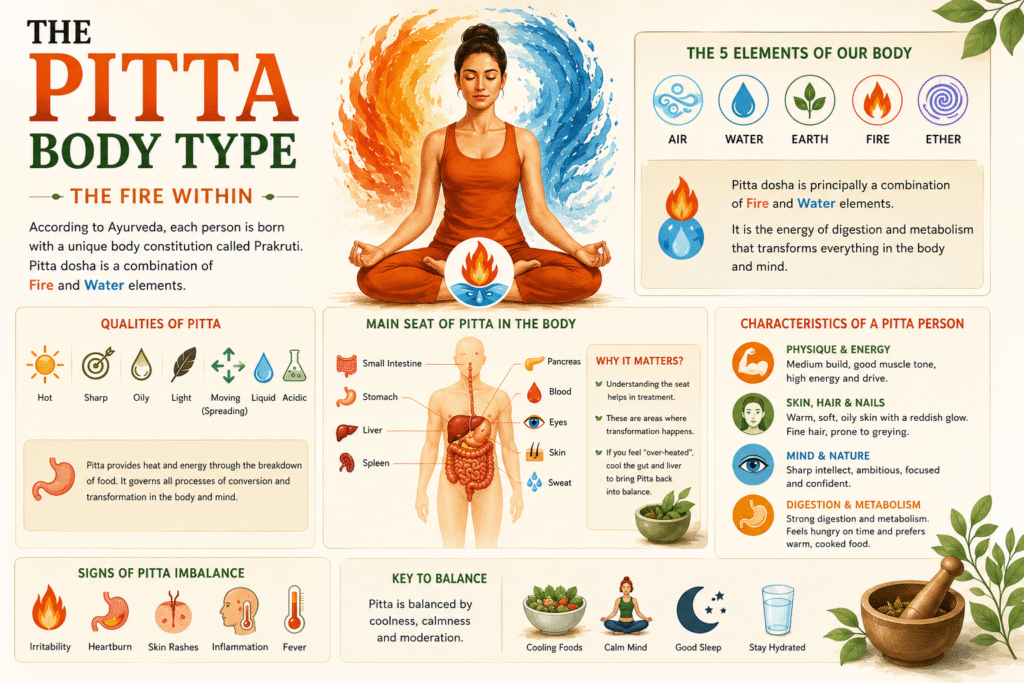
THE PITTA BODY TYPE According to Ayurveda, each one of us are born with a certain body constitution known as Prakruti. When we deviate from our natural constitution (due to stress, unhealthy diet, poor lifestyle, medicines etc.), we attract diseases. The diseased state or an imbalance in our energies is known as Dosha or Vikruti.  In Ayurveda there are 3 types of Doshas or body types – Vata, Pitta and Kapha. In this article we are going to discuss the Pitta Dosha!    Our body is made up of 5 elements air, water, earth, fire and ether.  Pitta dosha – is principally a combination of Fire and Water elements. The word Pitta is derived from the Sanskrit word “tap” meaning to heat and to be austere; and “translates as that which cooks.” It is the energy of digestion and metabolism in the body that functions through carrier substances such as organic acids, hormones, enzymes, bile and even the neurotransmitters and neuropeptides involved in thinking. Literally everything that enters the body needs to be “digested or cooked” from the sight of a full moon to a strawberry popped into the mouth. Some of pitta’s responsibilities are regulating the body heat through chemical transformation of food and giving a person appetite, vitality, learning and understanding.  The qualities of Pitta are – Hot, sharp, oily, light, moving or spreading, liquid and acidic. A pitta individual will display physical and mental characteristics that reflect these qualities in both balanced and imbalanced state.  Physiologically, Pitta provides the body with heat and energy through the breakdown of complex food molecules. It governs all processes related to conversion and transformation throughout the mind and body.  Psychologically, Pitta governs joy, courage, willpower, anger, jealousy, and mental perception. It also provides the radiant light of the intellect.  The main seat of Pitta in the body is the small intestine. It’s also located in stomach, liver, spleen, pancreas, blood, eyes, skin and sweat.  Why Knowing the “Seat” Matters?    Understanding the seat of a dosha helps in its treatment. Pitta is composed of Fire and Water elements. You’ll notice all its “seats  ” are areas where transformation happens: In the gut, food becomes energy. In the liver, toxins are processed. In the eyes, light becomes sight. In the skin, sunlight is synthesized and heat is released. Pro-Tip: If you feel “over-heated” (think heartburn, skin rashes, or irritability), Ayurveda suggests cooling these specific areas—especially the gut and the liver—to bring Pitta back into balance. The “Basement” Analogy: Think of the seats of the doshas like the utility rooms of a house. Vata is in the basement (colon), Pitta is on the ground floor (small intestine), and Kapha is in the attic (chest/head). If there’s a fire on the ground floor, you don’t run to the attic with a fire extinguisher—you go straight to the kitchen. Characteristics of a Pitta Individual    A Pitta individual is defined by the Fire and Water elements. Just like a steady flame, they are intense, transformative, and sharp. When balanced, they are brilliant leaders and “doers”; when out of balance, they can be a bit… combustible.  The balanced Pitta individual is blessed with a joyful disposition, a sharp intellect, and tremendous courage and drive. As the fire of the mind and body becomes unruly, however, the laughing Pitta quickly becomes the yelling – Pitta. Anger, rage, and ego replace Pitta’s positive attributes, leaving an individual who is bitter with life, and overbearing towards others. There is a saying that imbalanced Pitta individuals don’t go to hell; they simply create it wherever they go!  Pitta imbalances commonly manifest in the body as infection, inflammation, rashes, ulcers, heartburn and fever.  Physiological Characteristics of Pitta Person (The Pitta Body)    Physical Build and Energy Frame: Medium build with good muscle tone. They gain muscle more easily than Vata types but aren’t as naturally heavy-set as Kapha types. Physical Strength: They have moderate physical strength but high intensity. They often push themselves to the point of overheating during exercise. Sleep: They generally sleep soundly for moderate durations (6–7 hours). However, if their mind is overactive with a project, they may struggle to “turn off” the internal light. Skin, Hair and Nails Skin: The skin is typically warm, soft, and oily. It often has a reddish or pinkish undertone. They are prone to freckles, moles, and “hot” skin conditions like rashes, acne, or hives. Hair: Fine and silky; tends toward premature greying or thinning. Nails: Pink, soft, and flexible; typically, well-shaped and lustrous. Face and Senses Eyes: Pitta eyes are often very bright and sensitive to light. They frequently have a “sharp” or penetrating gaze. Many Pitta individuals end up needing glasses for nearsightedness due to the “heat” taxing the visual organ. Face: Heart-shaped or angular with sharp features (pointed nose/chin) and a glowing, reddish complexion. Senses: Sharp and acute; they have a strong sense of taste and a highly discerning “critical” eye. Digestion and Metabolism (The Powerhouse) The most defining physiological trait of a Pitta person is a strong, sharp appetite. Strong Digestion: They can typically digest almost anything, but they require regular meals. Their blood sugar tends to drop quickly if they don’t eat. Elimination: They usually have frequent, soft, or loose bowel movements. Because of their internal heat, they rarely struggle with constipation but may deal with “burning” during elimination if they eat spicy food. Cravings: They naturally gravitate toward cold drinks and sweet, cooling foods to balance their internal furnace. Thermoregulation and Energy Pitta types are “walking heaters.” Their bodies are constantly working to dissipate metabolic warmth. Body Temperature: Their hands and feet are usually warm to the touch, even in winter. Perspiration: They sweat easily and profusely, often with a strong or “sour” odor/fleshy smell. Energy level – Drive: High, focused, and steady energy. They are “doers” who push themselves until a task is finished. Endurance: Moderate to strong, but they tend to overheat. They are most energetic in cooler weather or during the early

Scroll to Top