
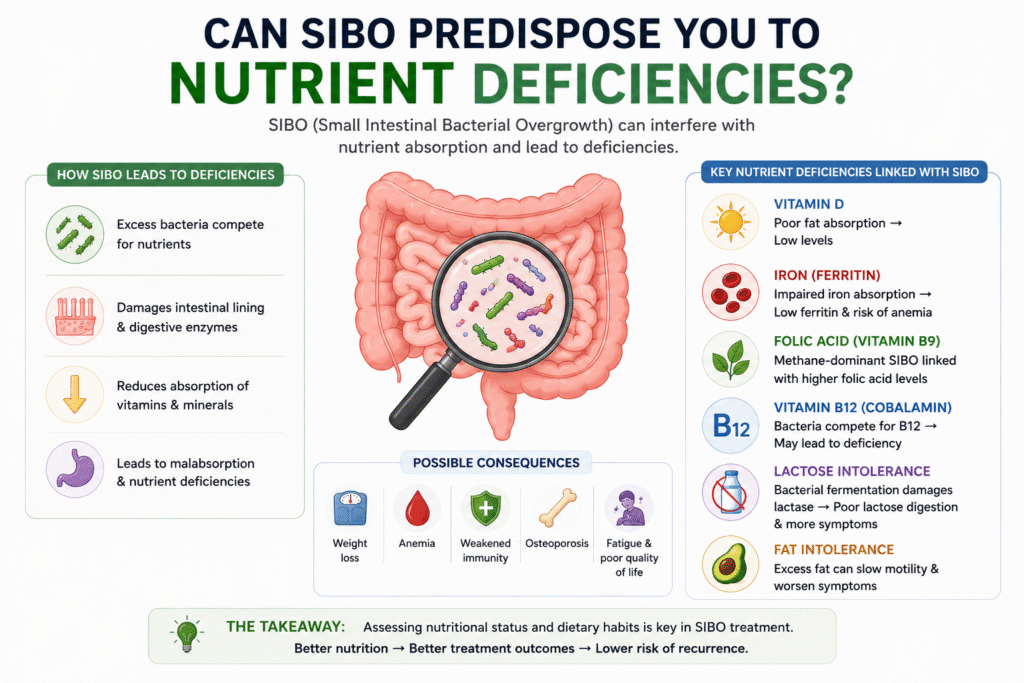
Can SIBO Predispose you to Nutrient Deficiencies?
Can SIBO Predispose you to Nutrient Deficiencies? Small intestinal bacterial overgrowth (SIBO) is a pathology of the small intestine and may predispose individuals to various nutritional deficiencies. The studies suggest that the subtypes of SIBO (Hydrogen and Methane dominant) may have varying effects on dietary intake, leading to a range of biochemical deficiencies. Conversely, specific dietary patterns (such as dairy, fiber, gluten, fat etc.) may predispose one to the development of a SIBO subtype. Diet is a modifiable factor that plays a crucial role in shaping the composition, diversity and stability of the gut microbiota (1). A diet rich in fiber and plant-based foods, supplemented with prebiotics and low in choline and fat is generally acknowledged to predispose one to a healthy microbiota (3). Conversely, a regimen deficient in fiber, fermentable oligosaccharides, disaccharides, monosaccharides and polyols (FODMAPs), and characterized by an elevated intake of omega-6 fatty acids typical of a Western dietary pattern, may predispose one to dysbiotic conditions (3,4). However, an approach in which proper care for gut microbiota nutrition is neglected may lead to nutritional deficiencies and microbiota alteration (5,6,7). Moreover, these issues can result in malabsorption, leading to nutritional deficiencies (vitamin A, D, E, B12), hypoproteinemia, anemia and weight loss (8,9,10). While SIBO is not a life-threatening condition, it can worsen the patient’s health and underlying comorbidities (11,12,13). Individuals experiencing gastrointestinal symptoms frequently turn to prolonged dietary restrictions, sometimes neglecting the significance of restoring microbial equilibrium in the gut (14,15). Furthermore, patients blindly choose to consume only permitted products, often leading to an inadequate intake of fiber, calcium or iron due to poor meal planning (16,17,18,19). However, it remains unclear whether a specific subtype of SIBO may predispose patients to a particular clinical presentation (i.e., nausea, diarrhea, constipation), which influences their dietary choices and patterns, or whether a patient’s baseline diet and nutritional intake may increase the risk of developing a specific SIBO subtype. A study by Wielgosz et al. (1) investigated the possible correlations between dietary intake (protein, fat and carbohydrates), serum levels of biochemical parameters (vitamin A, D, E, B12, folic acid, calcium, ferritin and iron) and SIBO subtypes in newly diagnosed SIBO patients. Adult participants between the ages of 18 to 65 years old presenting with existing abdominal symptoms occurring at least three times per month in the past six months were recruited. The study only included those individuals who newly had SIBO, confirmed through a non-invasive hydrogen–methane breath test with lactulose substrate (LHMB) and had not yet started antibiotic therapy or the use of the often-recommended elimination diet (1). The results are as follows: The H+/M+ group – was associated with low serum vitamin D (p < 0.001), low serum ferritin (p = 0.001) and low fiber intake (p = 0.001). The M+ group – was correlated with high serum folic acid (p = 0.002) and low intakes of fiber (p = 0.001) and lactose (p = 0.002). More than 50% of M+ dominant patients displayed a tendency towards iron deficiency. The H+ group – was associated with low lactose intake (p = 0.027). None of the H+-dominant patients exhibited iron deficiency. Moreover, over 50% of the H+ group exhibited optimal ferritin levels. Furthermore, it was noted that higher concentrations of exhaled H2 were associated with significantly lower levels of serum vitamin D. Lower serum ferritin concentrations were associated with higher levels of H2 gas production (p = 0.001, r = −0.5648). And it was observed that higher folate levels were solely associated with increased CH4 concentrations (p = 0.002, r = 0.6367). Regarding the intake of macronutrients and selected vitamins and minerals, four correlations were identified by the same study (1). In the H+/M+ group and M+ group, an association was observed between fiber intake and exhaled CH4 gas. The higher the concentration of CH4 gas production, the lower the intake of fiber in both groups. Lactose intake correlated with both H2 and CH4 gas production. In the H+ group, higher levels of exhaled H2 gas were associated with lower lactose intake in the diet (p = 0.027, r = −0.6338). Conversely, in the M+ group, a lower lactose intake was correlated with higher levels of exhaled CH4 gas (p = 0.002, r = −0.6444). The remaining parameters, including energy intake, protein, fat and carbohydrate intake, as well as vitamins A, D, E, B12, folate, and minerals such as calcium and iron, were not correlated with exhaled H2 or CH4 (1) Core-relation of Biochemical Parameters with SIBO Subtypes: Vitamin D – In the proximal part of the small intestine, SIBO may instigate the deconjugation of bile acids which reduce the solubilization of dietary fat within micelles (20). This alteration leads to the presence of unconjugated bile acids and a shift in their site of reabsorption, consequently leading to reduced absorption of fat-soluble vitamins (A, D, E) (20). Wielgosz et al. (1), in their research found that in the H+/M+ group, the concentration was 7155 ppm/min AUC, compared to 6160 ppm/min AUC in the H+ group and 2306 ppm/min AUC in the M+ group. However, the values only reached a statistically significant difference in the H+/M+ group and M+ group. It is important to consider that methane-producing Archaea are a hydrogen cross-feeder; hence, the lack of differences in H2 breath concentrations between the H+/M+ and H+ groups may be attributed to this phenomenon (21). Although each of the patients examined was recently diagnosed with SIBO, evidently, higher H2 levels in exhaled breath contributed to the impairment of vitamin D absorption, and a more pronounced state of dysbiosis could potentially affect this group (1). However, to date, few studies have assessed vitamin D levels in patients with SIBO, and none of these studies has correlated vitamin D levels and SIBO subtype. In a study conducted by Zhang et al., significantly lower serum vitamin D levels were observed in pregnant patients with gestational diabetes and SIBO, compared to a control group without SIBO (23). Among patients with concurrent SIBO and chronic pancreatitis or systemic sclerosis, no differences were noted in vitamin D levels compared to a group without SIBO (24,25) One consequence of vitamin D deficiency is hypocalcemia,