
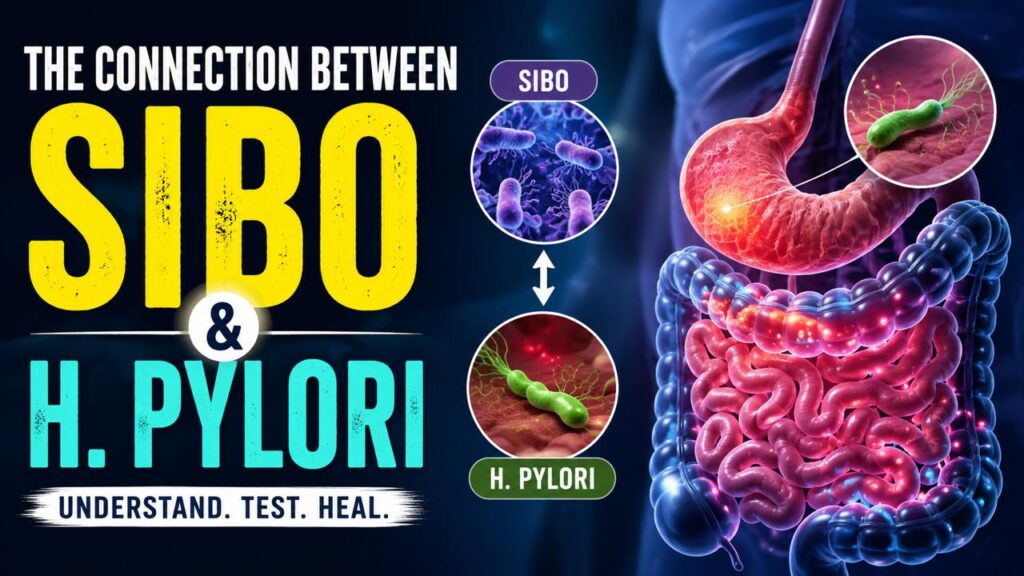
The connection between SIBO and H. Pylori
The connection between SIBO and H. Pylori Helicobacter pylori (H. pylori) infection is very common and affects a significant proportion of the world population with a prevalence rate in the United States between 20% and 40% (1). In contrast, the prevalence of small intestinal bacterial overgrowth (SIBO) in the general population is not well understood. There can be a coexistence of both disease states in a given patient, and their clinical symptoms may also overlap with one and another. However, there are no clear clinical guidelines for testing and treating SIBO in patients with H. pylori infection. Therefore, this article explores – the relationship between H. Pylori and SIBO as well as their association with other pathologies. The Big Question – If H. Pylori infection is associated with SIBO? Can H. Pylori infection predispose you to SIBO? Does H. Pylori infection create an environment ripe for SIBO? H. pylori enters the body through the mouth, moves through the digestive system, and infects the stomach or the first part of the small intestine. The spiral-shaped bacterium uses its tail-like flagella to move around and burrow into the stomach lining. This damages the gut lining and causes inflammation. H. pylori is a nasty pathogen that can persist in the stomach of infected persons for a lifetime, if left untreated. It provokes a chronic gastric inflammatory response, resulting in the development of several gastric pathological conditions including superficial gastritis, chronic atrophic gastritis, peptic ulcers, gastric cancer, and mucosa-associated lymphoid tissue (MALT) lymphoma (44). Although the majority of individuals colonized by H pyloriare asymptomatic, a proportion of patients develop peptic ulcers (duodenal and gastric), and an even smaller proportion develop gastric cancer. Globally, H pylori is the major cause of gastric cancer and has been classified as a Class I carcinogen by the WHO. Epidemiological studies have revealed that people with lower vegetable and micronutrient intake may be at increased risk of H. pylori infection (44). To successfully colonize the host and establish infection, H. pylori must be able to withstand an acidic stomach and adhere to host cells. In order, to survive the harsh acidic environment of the stomach, it produces a substance called Urease, a cytoplasmic enzyme. This substance helps them neutralize the stomach acid and is largely responsible for H. pylori’s acid tolerance (1). During active H. Pylori infection, this gram-negative bacteria uses urease to hydrolyze (convert) urea into ammonia and carbonic acid/carbon dioxide in the stomach. The ammonia byproduct buffers gastric acid leading to an increase in stomach pH to protect the organism and allow further proliferation (1). Over time, atrophy of the gastric mucosa (thinning, shrinking or wearing of gut lining) occurs permitting further multiplication of the bacteria. The preferred treatment of H. pylori infection includes a course of proton pump inhibitor (PPI) therapy (which further raises gastric pH) (5) and antibiotic agents which are also known to cause dysbiosis (because they wipe out good and bad bacteria both) and consequent gastrointestinal symptoms (6,7). Both mucosal atrophy and gastric pH alterations have been proposed to predispose patients to SIBO (1). In the general population, gastric secretions are strongly acidic with a pH range of 1 to 2. In non-H. pylori infection individuals, daily administration of 20 mg omeprazole (PPI) has been shown to increase gastric pH by 2 to a pH range of 3 to 4 (1). During H. pylori infection, individuals receiving this same dose of omeprazole showed increased stomach pH by a total of 4 to a pH range of 5 to 6 (8). Within the pH range of 5 to 6, enteric bacterial load can increase by as much as 1000-fold (11). This causes abnormalities in the intestinal flora. H. pylori often infects the stomach at a young age and significantly reduces the post-infection Firmicutes to Bacteroidetes ratio at the phylum level (9). Successful eradication of H. pylori increases the amount of Bifidobacterium in the intestinal flora (10). These bacteria (H. Pylori) are predominantly gram-negative anaerobes that produce gas with the fermentation of carbohydrates (when you eat food as in carbs). This gas fermentation allows for the detection of H. pylori infection by the urea breath test and the detection of SIBO by the hydrogen breath test (1). With that said, both bacterial load and the gas they produce contribute to the nonspecific constellation of gastrointestinal complaints (such as bloating, indigestion and acidity) as described in SIBO and H. pylori infection. A meta-analysis study conducted by Liao L et al. (2) pooled the results of eight eligible observational studies and found that H. Pylori infection may be related to SIBO in adults. Hence, the detection of SIBO should be considered for patients with digestive symptoms and HP infection. The study (2) results suggest that HP infection is associated with a higher prevalence of SIBO in younger adults (mean age <48 years) as compared to older adults (mean age >48 years). Subgroup analyses further indicated that the association was not significantly affected by the country of study, comorbidities, exposure to proton pump inhibitors, or methods of evaluating HP infection and SIBO (2). Helicobacter pylori infection is also a risk factor for various gastric diseases, such as chronic gastritis, peptic ulcers (gastric and duodenal), atrophic gastritis, and gastric cancer (12,13). Increasing studies suggest that besides gastric diseases, H. Pylori infection may also be involved in the pathogenesis of some intestinal disorders (14). For example, H. Pylori infection has been linked to the risk of colorectal adenomas (15) and colorectal cancer (16), as well as functional disorders such as IBS (17), suggesting a close relationship between H. Pylori infection and disturbed intestinal homeostasis. According to research studies, impaired gastric motility and/or acidity will likely boost bacterial growth in the small intestine and increase colonization (9,10) thus, creating an environment ripe for SIBO. Numerous studies have suggested an association of SIBO with, altered anatomy, hypochlorhydria (low stomach acid), dysmotility, immune deficiencies, and small intestinal disease and PPI use (18,19). Physically, the small intestine has relatively low-level colonized bacteria compared to the colon (8). Recent evidence from preclinical and clinical studies suggests that excessive bacterial growth in the small intestine, which is called small intestinal bacterial overgrowth (SIBO) (20),