
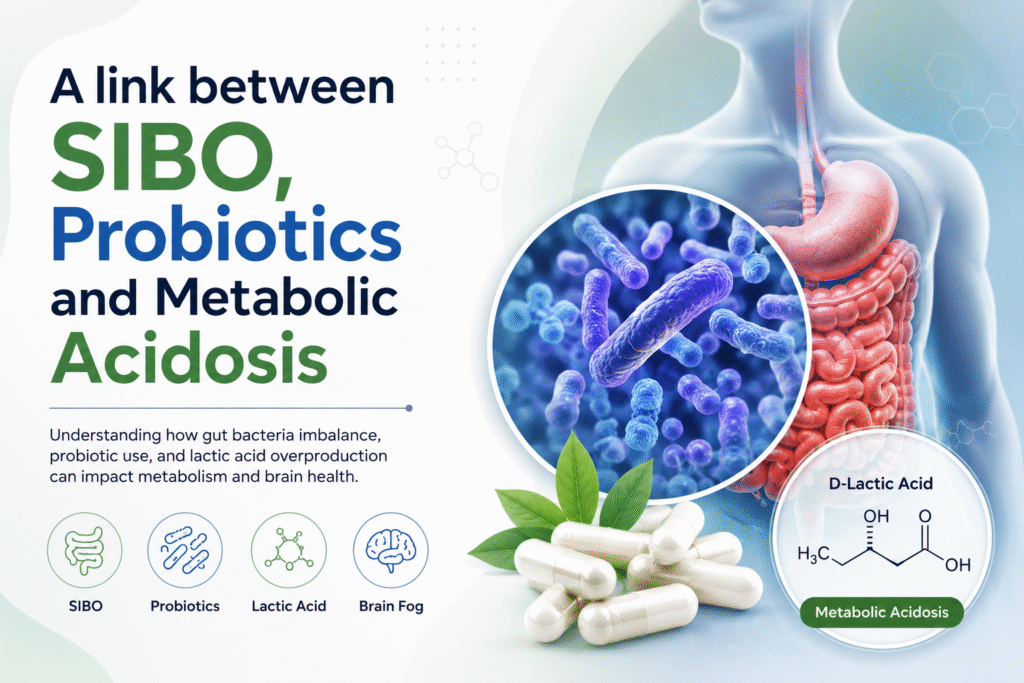
A link between SIBO, Probiotics and Metabolic Acidosis
Lactic acid is typically produced in excess at a rate of about 20 mmol/kg per day and enters the bloodstream, where it is primarily metabolized by the liver and kidneys. While some tissues can use lactate as a substrate and oxidize it to carbon dioxide (CO2) and water, only the liver and kidneys possess the necessary enzymes for gluconeogenesis from lactate. The tissues that typically produce excess lactic acid include the skin, red blood cells, brain tissue, muscles, and the gastrointestinal tract. During intense exercise, skeletal muscles are the primary source of elevated circulating lactate, which usually returns to normal levels if hepatic metabolism is unimpaired. Elevated lactate levels may result from increased production, decreased clearance, or a combination of both (2).
SIBO and D-Lactic Acidosis
D-lactic acidosis is an underrecognized complication that can occur in patients with small intestinal bacterial overgrowth, or SIBO, and dysbiosis of the gut microbiome (1).
Abdominal bloating, gas and distension are common gastrointestinal symptoms that are caused by many conditions including carbohydrate intolerance and small intestinal bacterial overgrowth (SIBO) (3). Brain Fogginess (BF) describes a constellation of symptoms comprised of mental confusion, impaired judgment, poor short-term memory, and difficulty with concentration, which is often transient and disabling. Previously, similar symptoms, along with slurred speech and gait disturbances have been described in patients with short bowel syndrome (4,5). These patients were found to have metabolic acidosis with elevated levels of D-lactic acid in the serum.
The L-isomer of lactic acid is the main form of lactic acid in the human body and is produced by the enzymatic (L-lactate dehydrogenase) reduction of pyruvate. D-lactate is produced in much smaller quantities by the enzyme D-2-hydroxyl acid dehydrogenase that also metabolizes D-lactate in the human liver (4).
In a healthy gut, D-lactate levels remain low because production is limited and clearance is efficient. However, in SIBO or severe dysbiosis, there is an overgrowth of bacteria—particularly species like Lactobacillus—that ferment carbohydrates into D-lactate (2).
In short bowel syndrome, if the colon is colonized by D-lactate producing bacteria, the delivery of large amounts of unabsorbed carbohydrate causes rapid fermentation, gaseous distension, and production of large amounts of d-lactic acid overwhelming hepatic clearance (6) and causing D-lactic acidosis and encephalopathy.
When excess carbohydrates reach the small intestine, these bacteria rapidly convert them into D-lactate, which is then absorbed into the bloodstream. Unlike L-lactate, the human body metabolizes D-lactate more slowly, leading to accumulation.
This buildup can result in D-lactic acidosis, characterized by metabolic acidosis and a range of neurological symptoms. Patients may present with confusion, brain fog, slurred speech, ataxia, or unusual behavior—often episodic and sometimes mistaken for psychiatric or neurologic disorders. Risk factors include short bowel syndrome, but it is increasingly recognized in patients with SIBO and significant gut dysbiosis, especially when high carbohydrate intake fuels bacterial fermentation.
Probiotics and D-Lactic Acidosis
The enzyme lactate dehydrogenase catalyzes the interconversion of pyruvate and lactate, stereospecific for the L-isomer (L-lactate), the predominant form synthesized and metabolized in humans. Although D-lactate is not a major component of normal mammalian metabolism, it can be produced in significant amounts by certain bacteria and yeast, particularly within the gastrointestinal tract.
Probiotics are considered to be safe and beneficial including improvement in gut barrier function and gut transit (7). Although a meta-analysis of 57 studies indicated that probiotics are safe (8), caution against its use has been recommended in subjects who are immunosuppressed, pregnant, and with structural heart lesions, acute abdomen, neutropenia, chemotherapy and radiotherapy (8,9).
Recently, probiotic use has been implicated in the production of D-lactic acidosis, both in short bowel syndrome patients and in the first 2 weeks of life in infants who were fed probiotic-containing formula (10,11). Typically, D-lactic acidosis is caused by the fermentation of ingested carbohydrates by D-lactic producing bacteria such as lactobacillus and bifidobacterium in the bowel (4,5).
Lactobacillus species and bifidobacterium are the most common bacteria in probiotic formulations (7,12) and are felt to be useful in the treatment of irritable bowel syndrome, inflammatory bowel disease, and other intestinal problems (13). Both bacteria produce D-lactic acid. D-lactic acidosis has been described with Salmonella enteritidis and with probiotics (14). Probiotics are designed to deliver bacteria to the colon but whether this is achieved has not been reliably shown (7,12-15). In contrast, they may colonize the small bowel, especially in the presence of dysmotility or low acid conditions that favor bacterial overgrowth.
Interestingly, some Lactobacillus species such as Lactobacillus GG only produce L-lactate (14,16). Hence, both D-lactate and L-lactate should be measured when assessing this condition, and the most practical way for its diagnosis is to administer a carbohydrate meal and assess D-lactate in urine and L-lactate in blood, over the next 3 h along with breath samples for hydrogen and methane.
Management focuses on reducing D-lactate production and correcting the underlying imbalance. This may include dietary carbohydrate restriction, targeted antibiotics for SIBO, probiotics in select cases, and correction of acid-base disturbances.
Reference Study
Rao et al. (1) studied a cohort of patients with an intact gut who reported brain fogginess associated with unexplained abdominal bloating, pain, gas and distension, and in whom there was evidence of probiotic use, D-lactic acidosis and SIBO. They found that over 2/3rd of patients with brain fogginess exhibited D-lactic acidosis, along with significantly higher prevalence of SIBO when compared to those without brain fogginess. Symptoms improved with the use of antibiotics and stopping probiotics. Hence, they advise caution against excessive and indiscriminate use of probiotics especially without a well-defined medical indication, and particularly in patients with gastrointestinal dysmotility, and/or those using long term PPI and opioids (1).
Conclusion
In summary, D-lactic acidosis is a clinically important but often overlooked consequence of SIBO and gut dysbiosis.
D-lactic acidosis is a rare but clinically significant subtype of lactic acidosis, typically observed in patients with short bowel syndrome or other forms of gastrointestinal malabsorption. In these individuals, undigested glucose and starch are fermented by colonic bacteria into various organic acids, including D-lactic acid—an isomer that humans metabolize poorly. Systemic absorption of D-lactate can lead to elevated plasma levels and metabolic acidosis.
Other causes of D-lactic acidosis include:
- High-dose intravenous infusions of propylene glycol (2) (commonly used as a solvent in intravenous medications)
- Diabetic ketoacidosis (17)
However, pathologic and persistent lactic acidosis occurs when 2 factors coexist—excessive lactate production and impaired hepatic clearance. When lactate production exceeds the liver’s capacity for metabolism, lactic acidosis becomes more severe.
Therefore, recognizing the link between microbial imbalance and metabolic symptoms is key to timely diagnosis and effective treatment.
References
- Rao SSC, Rehman A, Yu S, Andino NM. Brain fogginess, gas and bloating: a link between SIBO, probiotics and metabolic acidosis. Clin Transl Gastroenterol. 2018 Jun 19;9(6):162. doi: 10.1038/s41424-018-0030-7. PMID: 29915215; PMCID: PMC6006167.
- Baddam S, Tubben RE. Lactic Acidosis. [Updated 2025 Apr 28]. In: StatPearls [Internet]. Treasure Island (FL): StatPearls Publishing; 2026 Jan-. Available from: https://www.ncbi.nlm.nih.gov/books/NBK470202/
- Rao Satish S.C., Lee Yeong Yeh. Yamada’ s Textbook of Gastroenterology. Oxford, UK: John Wiley & Sons, Ltd; 2015. Approach to the Patient with Gas and Bloating; pp. 723–734. [Google Scholar]
- Oh MS, et al. D-lactic acidosis in a man with the short-bowel syndrome. N. Engl. J. Med. 1979;301:249–252. doi: 10.1056/NEJM197908023010505. [DOI] [PubMed] [Google Scholar]
- Uribarri J, Oh MS, Carroll HJ. D-lactic acidosis. A review of clinical presentation, biochemical features, and pathophysiologic mechanisms. Medicine. 1998;77:73–82. doi: 10.1097/00005792-199803000-00001. [DOI][PubMed] [Google Scholar]
- Petersen C. D-lactic acidosis. Nut Clin. Pract. 2005;20:634–645. doi:10.1177/0115426505020006634. [DOI] [PubMed] [Google Scholar]
- Hill C, et al. Expert consensus document. The International Scientific Association for Probiotics and Prebiotics consensus statement on the scope and appropriate use of the term probiotic. Nat. Rev. Gastroenterol. Hepatol. 2014;11:506–514. doi: 10.1038/nrgastro.2014.66. [DOI] [PubMed] [Google Scholar]
- Van den Nieuwboer M, Brummer RJ, Guarner F, Morelli L, Cabana M, Claassen E. The administration of probiotics and synbiotics in immune compromised adults: Is it safe? Benef. Microbes. 2015;6:3–17. doi: 10.3920/BM2014.0079. [DOI] [PubMed] [Google Scholar]
- Doron S, Snydman DR. Risk and safety of probiotics. Clin. Infect. Dis. 2015;60(Suppl 2):S2. doi: 10.1093/cid/civ085. [DOI] [PMC free article][PubMed] [Google Scholar]
- Papagaroufalis K, Fotiou A, Egli D, Tran LA, Steenhout P. A randomized double blind controlled safety trial evaluating d-lactic acid production in healthy infants fed a Lactobacillus reuteri-containing formula. Nutr. Metab. Insights. 2014;7:19–27. doi: 10.4137/NMI.S14113. [DOI] [PMC free article] [PubMed] [Google Scholar]
- Munakata S, et al. A case of D-lactic acid encephalopathy associated with use of probiotics. Brain. Dev. 2010;32:691–694. doi: 10.1016/j.braindev.2009.09.024. [DOI] [PubMed] [Google Scholar]
- Didari T, Solki S, Mozaffari S, Nikfar S, Abdollahi M. A systematic review of the safety of probiotics. Expert Opin. Durg Saf. 2014;13:227–239. doi: 10.1517/14740338.2014.872627. [DOI] [PubMed] [Google Scholar]
- Ford AC, et al. Efficacy of prebiotics, and synbiotics in irritable bowel syndrome and chronic idiopathic constipation: systematic review and meta-analysis. Am. J. Gastroenterol. 2014;109:1547–1561. doi: 10.1038/ajg.2014.202. [DOI] [PubMed] [Google Scholar]
- Gigante A, et al. D-Lactic acidosis 25 years after bariatic surgery due to Salmonella enteritidis. Nutrition. 2012;28:108–111. doi: 10.1016/j.nut.2011.07.005. [DOI] [PubMed] [Google Scholar]
- Jalali M, et al. Stability evaluation of freeze-dried Lactobacillus paracasei subsp. tolerance and Lactobacillus dellbrueckii subsp. bulgaricus in oral capsules. Res. Pharm. Sci. 2012;7:31–36. [PMC free article] [PubMed] [Google Scholar]
- Uchida H, et al. D-lactic acidosis in short-bowel syndrome managed with antibiotics and probiotics. J. Pediatr. Surg. 2004;39:634–636. doi: 10.1016/j.jpedsurg.2003.12.026. [DOI] [PubMed] [Google Scholar]
- Bianchetti DGAM, Amelio GS, Lava SAG, Bianchetti MG, Simonetti GD, Agostoni C, Fossali EF, Milani GP. D-lactic acidosis in humans: systematic literature review. Pediatr Nephrol. 2018 Apr;33(4):673-681. [PubMed]