
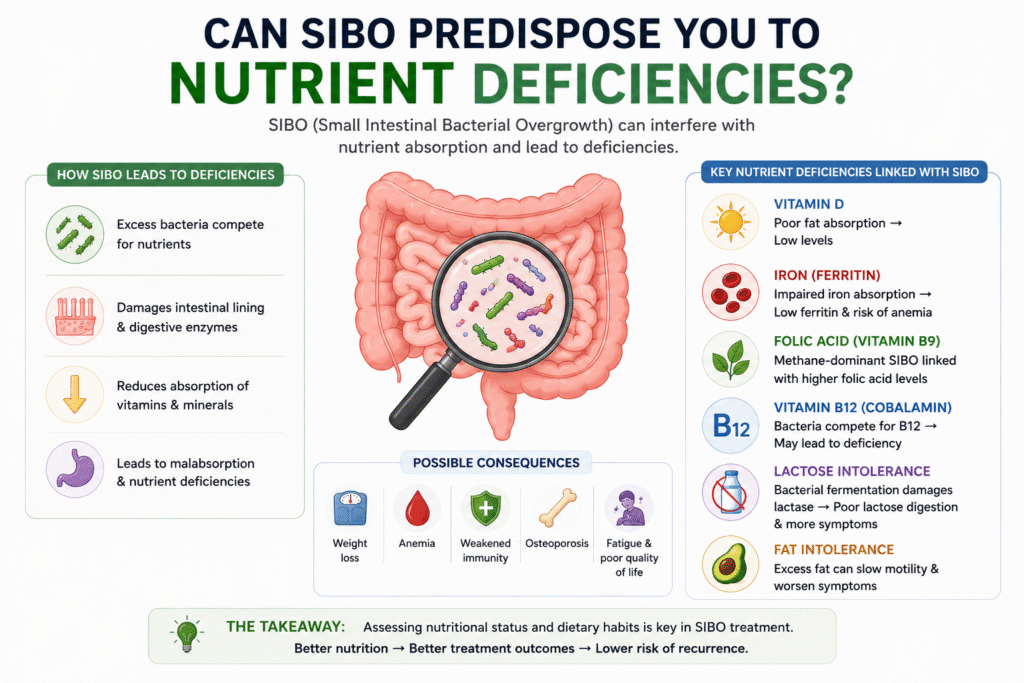
Can SIBO Predispose you to Nutrient Deficiencies?
Small intestinal bacterial overgrowth (SIBO) is a pathology of the small intestine and may predispose individuals to various nutritional deficiencies.
The studies suggest that the subtypes of SIBO (Hydrogen and Methane dominant) may have varying effects on dietary intake, leading to a range of biochemical deficiencies. Conversely, specific dietary patterns (such as dairy, fiber, gluten, fat etc.) may predispose one to the development of a SIBO subtype.
Diet is a modifiable factor that plays a crucial role in shaping the composition, diversity and stability of the gut microbiota (1). A diet rich in fiber and plant-based foods, supplemented with prebiotics and low in choline and fat is generally acknowledged to predispose one to a healthy microbiota (3). Conversely, a regimen deficient in fiber, fermentable oligosaccharides, disaccharides, monosaccharides and polyols (FODMAPs), and characterized by an elevated intake of omega-6 fatty acids typical of a Western dietary pattern, may predispose one to dysbiotic conditions (3,4). However, an approach in which proper care for gut microbiota nutrition is neglected may lead to nutritional deficiencies and microbiota alteration (5,6,7).
Moreover, these issues can result in malabsorption, leading to nutritional deficiencies (vitamin A, D, E, B12), hypoproteinemia, anemia and weight loss (8,9,10). While SIBO is not a life-threatening condition, it can worsen the patient’s health and underlying comorbidities (11,12,13).
Individuals experiencing gastrointestinal symptoms frequently turn to prolonged dietary restrictions, sometimes neglecting the significance of restoring microbial equilibrium in the gut (14,15). Furthermore, patients blindly choose to consume only permitted products, often leading to an inadequate intake of fiber, calcium or iron due to poor meal planning (16,17,18,19).
However, it remains unclear whether a specific subtype of SIBO may predispose patients to a particular clinical presentation (i.e., nausea, diarrhea, constipation), which influences their dietary choices and patterns, or whether a patient’s baseline diet and nutritional intake may increase the risk of developing a specific SIBO subtype.
A study by Wielgosz et al. (1) investigated the possible correlations between dietary intake (protein, fat and carbohydrates), serum levels of biochemical parameters (vitamin A, D, E, B12, folic acid, calcium, ferritin and iron) and SIBO subtypes in newly diagnosed SIBO patients. Adult participants between the ages of 18 to 65 years old presenting with existing abdominal symptoms occurring at least three times per month in the past six months were recruited. The study only included those individuals who newly had SIBO, confirmed through a non-invasive hydrogen–methane breath test with lactulose substrate (LHMB) and had not yet started antibiotic therapy or the use of the often-recommended elimination diet (1).
The results are as follows:
- The H+/M+ group – was associated with low serum vitamin D (p < 0.001), low serum ferritin (p = 0.001) and low fiber intake (p = 0.001).
- The M+ group – was correlated with high serum folic acid (p = 0.002) and low intakes of fiber (p = 0.001) and lactose (p = 0.002). More than 50% of M+ dominant patients displayed a tendency towards iron deficiency.
- The H+ group – was associated with low lactose intake (p = 0.027). None of the H+-dominant patients exhibited iron deficiency. Moreover, over 50% of the H+ group exhibited optimal ferritin levels.
- Furthermore, it was noted that higher concentrations of exhaled H2 were associated with significantly lower levels of serum vitamin D.
- Lower serum ferritin concentrations were associated with higher levels of H2 gas production (p = 0.001, r = −0.5648).
- And it was observed that higher folate levels were solely associated with increased CH4 concentrations (p = 0.002, r = 0.6367).
Regarding the intake of macronutrients and selected vitamins and minerals, four correlations were identified by the same study (1).
In the H+/M+ group and M+ group, an association was observed between fiber intake and exhaled CH4 gas. The higher the concentration of CH4 gas production, the lower the intake of fiber in both groups.
Lactose intake correlated with both H2 and CH4 gas production. In the H+ group, higher levels of exhaled H2 gas were associated with lower lactose intake in the diet (p = 0.027, r = −0.6338).
Conversely, in the M+ group, a lower lactose intake was correlated with higher levels of exhaled CH4 gas (p = 0.002, r = −0.6444).
The remaining parameters, including energy intake, protein, fat and carbohydrate intake, as well as vitamins A, D, E, B12, folate, and minerals such as calcium and iron, were not correlated with exhaled H2 or CH4 (1)
Core-relation of Biochemical Parameters with SIBO Subtypes:
- Vitamin D – In the proximal part of the small intestine, SIBO may instigate the deconjugation of bile acids which reduce the solubilization of dietary fat within micelles (20). This alteration leads to the presence of unconjugated bile acids and a shift in their site of reabsorption, consequently leading to reduced absorption of fat-soluble vitamins (A, D, E) (20).
Wielgosz et al. (1), in their research found that in the H+/M+ group, the concentration was 7155 ppm/min AUC, compared to 6160 ppm/min AUC in the H+ group and 2306 ppm/min AUC in the M+ group. However, the values only reached a statistically significant difference in the H+/M+ group and M+ group. It is important to consider that methane-producing Archaea are a hydrogen cross-feeder; hence, the lack of differences in H2 breath concentrations between the H+/M+ and H+ groups may be attributed to this phenomenon (21). Although each of the patients examined was recently diagnosed with SIBO, evidently, higher H2 levels in exhaled breath contributed to the impairment of vitamin D absorption, and a more pronounced state of dysbiosis could potentially affect this group (1).
However, to date, few studies have assessed vitamin D levels in patients with SIBO, and none of these studies has correlated vitamin D levels and SIBO subtype. In a study conducted by Zhang et al., significantly lower serum vitamin D levels were observed in pregnant patients with gestational diabetes and SIBO, compared to a control group without SIBO (23). Among patients with concurrent SIBO and chronic pancreatitis or systemic sclerosis, no differences were noted in vitamin D levels compared to a group without SIBO (24,25)
One consequence of vitamin D deficiency is hypocalcemia, and osteoporosis is a recognized manifestation of untreated SIBO (27). While it is well established that many individuals have lower than optimal vitamin D levels or suffer from vitamin D deficiency regardless of SIBO, the results of this study add to the limited number of available studies stating that vitamin D absorption may be further compromised by excessive bacterial fermentation in patients with SIBO (22,23,26)
- Ferritin and Iron – Ferritin is the most sensitive indicator of iron reserves and a valuable biomarker for evaluating iron deficiency (ID). According to the World Health Organization (WHO), low ferritin levels are defined as <15 μg/L for adults and <12 μg/L for children. Nevertheless, in clinical practice, iron deficiency can be identified when ferritin levels fall below 30 μg/L (28).
Iron is required for the replication and growth of almost all bacterial species. Approximately 5–20% of the iron is absorbed in the duodenum, and 80% of the iron ingested is used by the gut microbiota, mainly in the colon (71). The gut microbiota uses iron as a cofactor in proteins involved in metabolic pathways critical for its survival such as short-chain fatty acids production, DNA synthesis, redox reactions, and electron transport chain (71).
Increasing clinical studies evidence that the gut microbiota plays a critical role in iron metabolism and cognition. The associations of Serum Ferritin with cognition could be mediated by the gut microbiome through microbial-derived metabolites (2).
Iron is also involved in the production of myelin and neurotransmitter synthesis in the central nervous system (72). It has been proposed that serum ferritin (SF) can transport iron into cells, constituting the main pathway of iron supply to oligodendrocytes for myelin production (73). In fact, in a recent study in young adults, higher levels of SF were found to be associated with enhanced working memory (74).
There is an increased awareness that the gut microbiota plays a critical role in iron metabolism and cognition and recent observations linked impaired executive function (EF) to gut microbiota composition (75,76).
A recent study by Marisel et al. (2) found that Serum Ferritin was associated with increased Blautia hansenii, Fournierella massiliensis, and Lactobacillus rhamnosus. The genus Blautia is a well-known producer of short chain fatty acids (SCFAs), particularly acetic acid and butyric acid, and Blautia hansenii has been linked to less visceral fat accumulation (77). Fournierella massiliensis is also an acetic acid producer (78). SCFAs contribute to the integrity of the blood-brain barrier, inhibiting neuroinflammation and regulating the development and function of microglia (79). Lactobacillus rhamnosus has been associated with increased hippocampal neurogenesis, inhibiting the release of proinflammatory cytokines by the microglia, thus reducing hippocampal microgliosis and inflammation, (80,81) which are known to impair learning and memory (82). In mice, supplementation with Lactobacillus rhamnosus led to improved memory and EF (80,81) and, in subjects with mild cognitive impairment (82).
Another study by Wielgosz et al. (1) revealed that the lowest median level of ferritin (30.5 ng/mL), reflecting early iron deficiency, was observed in the H+/M+ group. This may suggest that the overgrowth of both H2 bacteria and CH4 Archaea predispose one to impaired iron absorption, thus reducing ferritin levels (1).
Often, in patients with insufficient iron stores in SIBO, oral iron supplementation is recommended (30). However, it is important to remember that iron may increase the levels of pathogenic bacteria, while simultaneously reducing beneficial ones (31). Iron is essential for methanogenic Archaea, as they depend on it for growth and metabolic processes (32). Elevated levels of intestinal CH4 have been linked to decreased intestinal motility, bloating and constipation (32,33). Therefore, considering iron supplementation in patients with iron deficiency and SIBO during bacterial eradication therapy seems to have negative consequences on the gut microbiota (32).
- Folic Acid – Many authors have postulated that SIBO is linked with normal or increased folate levels (34,35,36). It is known that bacteria have the ability to synthesize other vitamins. The gut microbiota contributes significantly to the production and utilization of folate (vitamin B9) (37). Based on an assessment of human gastrointestinal bacterial genomes, approximately 13.3% of bacteria are equipped with the capability of synthesizing folate de novo, while 39% have the potential to produce folic acid when supplied with additional para-aminobenzoic acid from either other microorganisms or food sources (38). Altogether, the microbiome holds promising therapeutic potential for addressing vitamin B9 levels.
The study by Wielgosz et al. (1) found a distinct correlation between CH4 producing Achaea and a heightened synthesis of serum folic acid. Also, one previous study by Platovsky et al. found that participants with higher folate levels had a 1.75 times greater likelihood of having SIBO than those with normal folate levels (95% CI = 0.74–4.14) (39). On the other hand, other studies, such as those by Marie et al. and Tauber et al., only studied patients with systemic sclerosis and did not find any differences in serum folic acid between the SIBO group and the control group (25,40). In contrast, Kaniel et al. showed that a lower serum folate level in SIBO patients after one-anastomosis gastric bypass surgery did not differ when compared to patients without SIBO (41).
- Vitamin B12 (Cobalamin) – Vitamin B-12 is required for DNA synthesis and methylation and folate metabolism; vitamin B-12 deficiency can lead to impairments in cell division, erythropoiesis, DNA stability, and neurological function (44,45)
Vitamin B-12 is synthesized exclusively by bacteria and is obtained in the diet through consumption of animal-source foods (42,46). In addition to inadequate dietary intake, vitamin B-12 deficiency can result from low bioavailability or impaired absorption, due to pernicious anemia (an autoimmune disease affecting parietal cells and release of intrinsic factor, required for vitamin B-12 absorption); atrophic gastritis, malabsorption, and risk of pernicious anemia, which increase with age; medications (e.g., proton pump inhibitors); and gastrointestinal diseases (e.g., inflammatory bowel disease) or gastrointestinal infections (e.g., Helicobacter pylori, intestinal helminths) (43,45,46,47). It is worth noting that SIBO is marked by the heightened colonization of both anaerobic and aerobic microorganisms within the small intestine, with a predominance of Gram-negative species. Studies in humans suggest that bacterial overgrowth in the small intestines [i.e., predominantly Gram-negative colonic bacteria (48) can lead to vitamin B-12 deficiency, likely via competition and malabsorption of available vitamin B-12 (49-51).
Bacteria in the human gastrointestinal (gut) microbiome synthesize vitamin B-12 and utilize unabsorbed vitamin B-12 from the host (52). Humans absorb ∼50% of vitamin B-12 at a 1-μg oral dose in the ileum (lower part of the small intestine), and absorption decreases with increasing dose (53). Vitamin B-12 not absorbed in the ileum can reach the large intestine, where gut bacteria metabolize and convert ∼80% of vitamin B-12 into vitamin B-12 analogs (i.e., cobamides with no known vitamin B-12 activity) by altering the benzimidazole base of vitamin B-12 (50,54). The ability to utilize vitamin B-12 (and vitamin B-12 analogs) may be a competitive advantage for certain bacteria (52,55,56). Further, the gut microbiota composition and function may differ in environments that are replete in vitamin B-12 compared with those with inadequate vitamin B-12.
The results of study by Wielgosz et al. (1) demonstrated that the level of vitamin B12 was not associated with any type of bacterial overgrowth in patients with SIBO, regardless of SIBO subtype. Perhaps in the case of vitamin B12 levels, at such an early stage of overgrowth, their patients did not experience significant deficiencies in vitamin B12. However, there is only one study by Madigan et al. (57) that investigated the relationship between vitamin B12 and the SIBO phenotype and revealed that methanogenic SIBO manifested only in an older population and was linked to a reduced occurrence of vitamin B12 deficiency.
Although, the majority of bacteria and Archaea lack the enzymatic ability to synthesize cobalamin de novo (58); Methanobrevibacter smithii, the primary methane-producing Archaea in the gut microbiota, is able to synthesize cobalamin. Consequently, an abundance of methanogens in SIBO is expected to have some influence on the availability of vitamin B12 to the host (58). Also, the absorption of vitamin B12 acquired from food can be hindered by gut bacteria that compete with the host for nutrients or by damage to cobalamin binding sites on the mucosa (35).
- Lactose intolerance – It is well established that SIBO contributes to malabsorption syndrome (63). The overgrowth of microorganisms leads to the reduced availability of sugars consumed by bacteria (22). Bacteria release toxins and metabolic byproducts, which can impair the integrity of the epithelial layer covering the intestinal villi (22). Consequently, this diminishes the function of brush border disaccharidases and impairs disaccharide digestion such as lactose (61).
The increased bacterial fermentation of carbohydrates notably induces abdominal symptoms, especially an elevated production of H2 gas, which is primarily associated with IBS–diarrhea (62). Signs of lactose intolerance commonly appear when lactase activity falls below 50% (64). Furthermore, the majority of people with lactase non-persistence can manage small quantities of lactose (less than 12 g, roughly equivalent to one cup), particularly when consumed alongside other products in the diet or when divided throughout the day (64).
According to Jo et al. (59) H2-dominant SIBO was found to be significantly more prevalent in patients with a lactase deficiency compared to healthy controls, with rates of 27.6% versus 6.7%, respectively. In another study, SIBO was recorded in 90% of elderly individuals diagnosed with lactose malabsorption (LM), compared to 20% of a control group (60). The eradication of bacterial overgrowth corresponded with the alleviation of LM (60). A retrospective analysis unveiled a prevalence of carbohydrate malabsorption among patients undergoing the lactulose breath test and emphasized that SIBO may elevate the probability of lactose intolerance. However, intolerance in such cases is reversible with an appropriate SIBO treatment (61).
The study by Wielgosz et al. (1) is the first study to evaluate lactose consumption in patients with specific SIBO subtypes. Their research found that the H+ group had the lowest amount of lactose consumption. This was attributed to the higher degree of diarrhea associated with lactose consumption; owing to elevated levels of Hydrogen gas produced in the H2 dominant group as was demonstrated in their previous study (65). However, since low lactose intake was found in both the H+ and M+ groups, the results align with the current literature that supports the contention that patients with SIBO are likely already consuming less lactose at baseline for symptom control.
- Fat intake – In clinical practice, it is often observed that patients with SIBO independently increase the fat intake in their diet due to symptoms experienced after consuming carbohydrates. However, it is essential to remember that certain types of fat can either positively or negatively affect the gut microbiota and colonic pH (4). Laboratory studies have indeed shown that lipids in the duodenum can slow down small bowel movement and interfere with the clearance of intestinal gas, which leads to gas retention and bloating (66). A systematic review has indicated that dietary fat may have a significant impact on the onset of symptoms related to functional dyspepsia (67).
The study by Wielgosz et al. (1) is the first study to evaluate fat intake based on SIBO subtype. Thy found that the H2 dominant group consumed significantly less fat compared to the other two groups. On the other hand, over 70% of patients in the M+ and H+/M+ groups had an excessive fat intake compared to the recommended dietary guidelines. They concluded that the lower fat intake in the H+ group could have been influenced by a higher degree of diarrhea and poor fat tolerance.
Furthermore, before these results, one study conducted on Sprague Dawley rats revealed that animals fed a high-fat diet exhibited a higher abundance of Methanobrevibacter smithii in the duodenum, ileum and cecum compared to those fed a normal diet (70). Only three other studies have assessed the total fat intake in patients with SIBO and without SIBO by using the hydrogen breath test or hydrogen–methane breath test (14,68,69). None of the authors found any significant differences in fat intake between the SIBO group and the control group (14,68,69). Therefore, depending on the type of overgrowth and current symptoms, the appropriate fat requirements should be determined.
Additionally, as per Wielgosz et al. (1) research, the remaining dietary components such as energy intake, protein, total carbohydrates, fructose, Saturated fatty acid (SFA), Mono-unsaturated Fatty Acid (MUFA), Polyunsaturated Fatty Acid (PUFA), omega-3/omega-6 ratio, cholesterol, vitamin A and E, folic acid, calcium and iron, were not associated with any changes based on the type of SIBO. Also, so far, there are no previous studies that have assessed the intake of these parameters and SIBO subtypes.
Conclusion
This information suggests that the type of SIBO may have varying effects on the nutritional status of patients, leading to a range of deficiencies in the body. Furthermore, the consumption of certain nutrients by patients may result from a particular type of microbial overgrowth, predisposing them to certain gastrointestinal symptoms. Additionally, an inadequate or excessive intake of specific foods may predispose individuals to the development of a particular type of SIBO. Therefore, the assessment of the nutritional status and dietary habits of patients with SIBO should be a key component of bacterial eradication therapy. The improved nutritional status of patients can lead to greater treatment efficacy and may also contribute to reducing the risk of SIBO recurrence. Often, recurrence arises from focusing solely on the functioning of the small intestine, neglecting the role of the large intestine as a primary contributor to gut microbiota.
References
- Wielgosz-Grochowska JP, Domanski N, Drywień ME. Identification of SIBO Subtypes along with Nutritional Status and Diet as Key Elements of SIBO Therapy. Int J Mol Sci. 2024 Jul 4;25(13):7341. doi: 10.3390/ijms25137341. PMID: 39000446; PMCID: PMC11242202.
- Rosell-Díaz M, Santos-González E, Motger-Albertí A, Ramió-Torrentà L, Garre-Olmo J, Pérez-Brocal V, Moya A, Jové M, Pamplona R, Puig J, Ramos R, Fernández-Real JM, Mayneris-Perxachs J. Gut microbiota links to serum ferritin and cognition. Gut Microbes. 2023 Dec;15(2):2290318. doi: 10.1080/19490976.2023.2290318. Epub 2023 Dec 7. PMID: 38059755; PMCID: PMC10730210.
- Hills R.D., Pontefract B.A., Mishcon H.R., Black C.A., Sutton S.C., Theberge C.R. Gut Microbiome: Profound Implications for Diet and Disease. Nutrients. 2019;11:1613. doi: 10.3390/nu11071613. [DOI] [PMC free article] [PubMed] [Google Scholar]
- Singh R.K., Chang H.W., Yan D., Lee K.M., Ucmak D., Wong K., Abrouk M., Farahnik B., Nakamura M., Zhu T.H., et al. Influence of Diet on the Gut Microbiome and Implications for Human Health. J. Transl. Med. 2017;15:73. doi: 10.1186/s12967-017-1175-y. [DOI] [PMC free article] [PubMed] [Google Scholar]
- Souza C., Rocha R., Cotrim H.P. Diet and Intestinal Bacterial Overgrowth: Is There Evidence? World J. Clin. Cases. 2022;10:4713–4716. doi: 10.12998/wjcc.v10.i15.4713. [DOI] [PMC free article] [PubMed] [Google Scholar]
- Halmos E.P., Power V.A., Shepherd S.J., Gibson P.R., Muir J.G. A Diet Low in FODMAPs Reduces Symptoms of Irritable Bowel Syndrome. Gastroenterology. 2014;146:67–75.e5. doi: 10.1053/j.gastro.2013.09.046. [DOI] [PubMed] [Google Scholar]
- Wielgosz-Grochowska J.P., Domanski N., Drywień M.E. Efficacy of an Irritable Bowel Syndrome Diet in the Treatment of Small Intestinal Bacterial Overgrowth: A Narrative Review. Nutrients. 2022;14:3382. doi: 10.3390/nu14163382. [DOI] [PMC free article] [PubMed] [Google Scholar]
- Losurdo G., Leandro G., Ierardi E., Perri F., Barone M., Principi M., Di Leo A. Breath Tests for the Non-Invasive Diagnosis of Small Intestinal Bacterial Overgrowth: A Systematic Review with Meta-Analysis. J. Neurogastroenterol. Motil. 2020;26:16–28. doi: 10.5056/jnm19113. [DOI] [PMC free article] [PubMed] [Google Scholar]
- Adike A., DiBaise J.K. Small Intestinal Bacterial Overgrowth: Nutritional Implications, Diagnosis, and Management. Gastroenterol. Clin. N. Am. 2018;47:193–208. doi: 10.1016/j.gtc.2017.09.008. [DOI] [PubMed] [Google Scholar]
- Shah A., Talley N.J., Holtmann G. Current and Future Approaches for Diagnosing Small Intestinal Dysbiosis in Patients with Symptoms of Functional Dyspepsia. Front. Neurosci. 2022;16:830356. doi: 10.3389/fnins.2022.830356. [DOI] [PMC free article] [PubMed] [Google Scholar]
- Shah A., Morrison M., Burger D., Martin N., Rich J., Jones M., Koloski N., Walker M.M., Talley N.J., Holtmann G.J. Systematic Review with Meta-Analysis: The Prevalence of Small Intestinal Bacterial Overgrowth in Inflammatory Bowel Disease. Aliment. Pharmacol. Ther. 2019;49:624–635. doi: 10.1111/apt.15133. [DOI] [PubMed] [Google Scholar]
- Ghoshal U.C., Shukla R., Ghoshal U. Small Intestinal Bacterial Overgrowth and Irritable Bowel Syndrome: A Bridge between Functional Organic Dichotomy. Gut Liver. 2017;11:196–208. doi: 10.5009/gnl16126. [DOI] [PMC free article] [PubMed] [Google Scholar]
- Losurdo G., D’abramo F.S., Indellicati G., Lillo C., Ierardi E., Di Leo A. The Influence of Small Intestinal Bacterial Overgrowth in Digestive and Extra-Intestinal Disorders. Int. J. Mol. Sci. 2020;21:3531. doi: 10.3390/ijms21103531. [DOI] [PMC free article] [PubMed] [Google Scholar]
- Ierardi E., Losurdo G., Sorrentino C., Giorgio F., Rossi G., Marinaro A., Romagno K.R., Di Leo A., Principi M. Macronutrient Intakes in Obese Subjects with or without Small Intestinal Bacterial Overgrowth: An Alimentary Survey. Scand. J. Gastroenterol. 2016;51:277–280. doi: 10.3109/00365521.2015.1086020. [DOI] [PubMed] [Google Scholar]
- Leeming E.R., Johnson A.J., Spector T.D., Roy C.I.L. Effect of Diet on the Gut Microbiota: Rethinking Intervention Duration. Nutrients. 2019;11:2862. doi: 10.3390/nu11122862. [DOI] [PMC free article] [PubMed] [Google Scholar]
- Losso J.N. Food Processing, Dysbiosis, Gastrointestinal Inflammatory Diseases, and Antiangiogenic Functional Foods or Beverages. Annu. Rev. Food Sci. Technol. 2021;12:235–258. doi: 10.1146/annurev-food-062520-090235. [DOI] [PubMed] [Google Scholar]
- Staudacher H.M., Ralph F.S.E., Irving P.M., Whelan K., Lomer M.C.E. Nutrient Intake, Diet Quality, and Diet Diversity in Irritable Bowel Syndrome and the Impact of the Low FODMAP Diet. J. Acad. Nutr. Diet. 2020;120:535–547. doi: 10.1016/j.jand.2019.01.017. [DOI] [PubMed] [Google Scholar]
- Bellini M., Tonarelli S., Nagy A.G., Pancetti A., Costa F., Ricchiuti A., de Bortoli N., Mosca M., Marchi S., Rossi A. Low FODMAP Diet: Evidence, Doubts, and Hopes. Nutrients. 2020;12:148. doi: 10.3390/nu12010148. [DOI] [PMC free article] [PubMed] [Google Scholar]
- Staudacher H.M., Scholz M., Lomer M.C., Ralph F.S., Irving P.M., Lindsay J.O., Fava F., Tuohy K., Whelan K. Gut Microbiota Associations with Diet in Irritable Bowel Syndrome and the Effect of Low FODMAP Diet and Probiotics. Clin. Nutr. 2021;40:1861–1870. doi: 10.1016/j.clnu.2020.10.013. [DOI] [PubMed] [Google Scholar]
- Miazga A., Osiński M., Cichy W., Zaba R. Current Views on the Etiopathogenesis, Clinical Manifestation, Diagnostics, Treatment and Correlation with Other Nosological Entities of SIBO. Adv. Med. Sci. 2015;60:118–124. doi: 10.1016/j.advms.2014.09.001. [DOI] [PubMed] [Google Scholar]
- Smith N.W., Shorten P.R., Altermann E.H., Roy N.C., McNabb W.C. Hydrogen Cross-Feeders of the Human Gastrointestinal Tract. Gut Microbes. 2019;10:270–288. doi: 10.1080/19490976.2018.1546522. [DOI] [PMC free article] [PubMed] [Google Scholar]
- Miazga A., Osiński M., Cichy W., Zaba R. Current Views on the Etiopathogenesis, Clinical Manifestation, Diagnostics, Treatment and Correlation with Other Nosological Entities of SIBO. Adv. Med. Sci. 2015;60:118–124. doi: 10.1016/j.advms.2014.09.001. [DOI] [PubMed] [Google Scholar]
- Zhang M., Xu Y., Zhang J., Sun Z., Ban Y., Wang B., Hou X., Cai Y., Li J., Wang M., et al. Application of Methane and Hydrogen-Based Breath Test in the Study of Gestational Diabetes Mellitus and Intestinal Microbes. Diabetes Res. Clin. Pract. 2021;176:108818. doi: 10.1016/j.diabres.2021.108818. [DOI] [PubMed] [Google Scholar]
- Lee A.A., Baker J.R., Wamsteker E.J., Saad R., DiMagno M.J. Small Intestinal Bacterial Overgrowth Is Common in Chronic Pancreatitis and Associates with Diabetes, Chronic Pancreatitis Severity, Low Zinc Levels, and Opiate Use. Am. J. Gastroenterol. 2019;114:1163–1171. doi: 10.14309/ajg.0000000000000200. [DOI] [PMC free article] [PubMed] [Google Scholar]
- Tauber M., Avouac J., Benahmed A., Barbot L., Coustet B., Kahan A., Allanore Y. Prevalence and Predictors of Small Intestinal Bacterial Overgrowth in Systemic Sclerosis Patients with Gastrointestinal Symptoms. Clin. Exp. Rheumatol. 2014;32:5–10. [PubMed] [Google Scholar]
- Kubota Y., Nagano H., Ishii K., Kono T., Kono S., Akita S., Mitsukawa N., Tanaka T. Small Intestinal Bacterial Overgrowth as a Cause of Protracted Wound Healing and Vitamin D Deficiency in a Spinal Cord Injured Patient with a Sacral Pressure Sore: A Case Report. BMC Gastroenterol. 2020;20:283. doi: 10.1186/s12876-020-01423-8. [DOI] [PMC free article] [PubMed] [Google Scholar]
- Stotzer P.O., Johansson C., Mellström D., Lindstedt G., Kilander A.F. Bone Mineral Density in Patients with Small Intestinal Bacterial Overgrowth. Hepatogastroenterology. 2003;50:1415–1418. [PubMed] [Google Scholar]
- Daru J., Allotey J., Peña-Rosas J.P., Khan K.S. Serum Ferritin Thresholds for the Diagnosis of Iron Deficiency in Pregnancy: A Systematic Review. Transfus. Med. 2017;27:167–174. doi: 10.1111/tme.12408. [DOI] [PMC free article] [PubMed] [Google Scholar]
- Bohm M., Shin A., Teagarden S., Xu H., Gupta A., Siwiec R., Nelson D., Wo J.M. Risk Factors Associated with Upper Aerodigestive Tract or Coliform Bacterial Overgrowth of the Small Intestine in Symptomatic Patients. J. Clin. Gastroenterol. 2020;54:150–157. doi: 10.1097/MCG.0000000000001150. [DOI] [PMC free article] [PubMed] [Google Scholar]
- Lopez A., Cacoub P., Macdougall I.C., Peyrin-Biroulet L. Iron Deficiency Anaemia. Lancet. 2016;387:907–916. doi: 10.1016/S0140-6736(15)60865-0. [DOI] [PubMed] [Google Scholar]
- Braun V. Iron Uptake Mechanisms and Their Regulation in Pathogenic Bacteria. Int. J. Med. Microbiol. 2001;291:67–79. doi: 10.1078/1438-4221-00103. [DOI] [PubMed] [Google Scholar]
- Bloor S.R., Schutte R., Hobson A.R. Oral Iron Supplementation—Gastrointestinal Side Effects and the Impact on the Gut Microbiota. Microbiol. Res. 2021;12:491–502. doi: 10.3390/microbiolres12020033. [DOI] [Google Scholar]
- Triantafyllou K., Chang C., Pimentel M. Methanogens, Methane and Gastrointestinal Motility. J. Neurogastroenterol. Motil. 2014;20:31–40. doi: 10.5056/jnm.2014.20.1.31. [DOI] [PMC free article] [PubMed] [Google Scholar]
- Achufusi T.G.O., Sharma A., Zamora E.A., Manocha D. Small Intestinal Bacterial Overgrowth: Comprehensive Review of Diagnosis, Prevention, and Treatment Methods. Cureus. 2020;12:e8860. doi: 10.7759/cureus.8860. [DOI] [PMC free article] [PubMed] [Google Scholar]
- Quigley E.M.M., Murray J.A., Pimentel M. AGA Clinical Practice Update on Small Intestinal Bacterial Overgrowth: Expert Review. Gastroenterology. 2020;159:1526–1532. doi: 10.1053/j.gastro.2020.06.090. [DOI] [PubMed] [Google Scholar]
- Zaidel O., Lin H.C. Uninvited Guests: The Impact of Small Intestinal Bacterial Overgrowth on Nutritional Status. Pract. Gastroenterol. 2003;27:27–30+33. [Google Scholar]
- Kok D.E., Steegenga W.T., Smid E.J., Zoetendal E.G., Ulrich C.M., Kampman E. Bacterial Folate Biosynthesis and Colorectal Cancer Risk: More than Just a Gut Feeling. Crit. Rev. Food Sci. Nutr. 2020;60:244–256. doi: 10.1080/10408398.2018.1522499. [DOI] [PubMed] [Google Scholar]
- Engevik M.A., Morra C.N., Röth D., Engevik K., Spinler J.K., Devaraj S., Crawford S.E., Estes M.K., Kalkum M., Versalovic J. Microbial Metabolic Capacity for Intestinal Folate Production and Modulation of Host Folate Receptors. Front. Microbiol. 2019;10:2305. doi: 10.3389/fmicb.2019.02305. [DOI] [PMC free article] [PubMed] [Google Scholar]
- Platovsky A., Tokayer A. Folate Levels in Patients with Small Intestinal Bacterial Overgrowth (SIBO) Am. J. Gastroenterol. 2014;109:S530. doi: 10.14309/00000434-201410002-01790. [DOI] [Google Scholar]
- Marie I., Ducrotté P., Denis P., Menard J.F., Levesque H. Small Intestinal Bacterial Overgrowth in Systemic Sclerosis. Rheumatology. 2009;48:1314–1319. doi: 10.1093/rheumatology/kep226. [DOI] [PubMed] [Google Scholar]
- Kaniel O., Sherf-Dagan S., Szold A., Langer P., Khalfin B., Kessler Y., Raziel A., Sakran N., Motro Y., Goitein D., et al. The Effects of One Anastomosis Gastric Bypass Surgery on the Gastrointestinal Tract. Nutrients. 2022;14:304. doi: 10.3390/nu14020304. [DOI] [PMC free article] [PubMed] [Google Scholar]
- Allen LH. How common is vitamin B-12 deficiency?. Am J Clin Nutr. 2009;89(2):693S–6S. [DOI] [PubMed] [Google Scholar]
- Green R, Allen LH, Bjorke-Monsen AL, Brito A, Gueant JL, Miller JW, Molloy AM, Nexo E, Stabler S, Toh BHet al. Vitamin B12 deficiency. Nat Rev Dis Primers. 2017;3(1):17040. doi: 10.1038/nrdp.2017.40. [DOI] [PubMed] [Google Scholar]
- McLean E, de Benoist B, Allen LH. Review of the magnitude of folate and vitamin B12 deficiencies worldwide. Food Nutr Bull. 2008;29:S38–51. [DOI] [PubMed] [Google Scholar]
- Finkelstein JL, Layden AJ, Stover PJ. Vitamin B-12 and perinatal health. Adv Nutr. 2015;6(5):552–63. [DOI] [PMC free article] [PubMed] [Google Scholar]
- Allen LH. Causes of vitamin B12 and folate deficiency. Food Nutr Bull. 2008;29(2 Suppl 1):S20–34.; discussion S5–7. [DOI] [PubMed] [Google Scholar]
- Layden AJ, Tase K, Finkelstein JL. Neglected tropical diseases and vitamin B12: a review of the current evidence. Trans R Soc Trop Med Hyg. 2018;112(10):423–35. [DOI] [PMC free article] [PubMed] [Google Scholar]
- Leite G, Morales W, Weitsman S, Celly S, Parodi G, Mathur R, Barlow GM, Sedighi R, Millan MJV, Rezaie Aet al. The duodenal microbiome is altered in small intestinal bacterial overgrowth. PLoS One. 2020;15(7):e0234906. doi: 10.1371/journal.pone.0234906. [DOI] [PMC free article] [PubMed] [Google Scholar]
- Albert MJ, Mathan VI, Baker SJ. Vitamin B12 synthesis by human small intestinal bacteria. Nature. 1980;283(5749):781–2. [DOI] [PubMed] [Google Scholar]
- Brandt LJ, Bernstein LH, Wagle A. Production of vitamin B 12 analogues in patients with small-bowel bacterial overgrowth. Ann Intern Med. 1977;87(5):546–51. [DOI] [PubMed] [Google Scholar]
- Murphy MF, Sourial NA, Burman JF, Doyle DV, Tabaqchali S, Mollin DL. Megaloblastic anaemia due to vitamin B12 deficiency caused by small intestinal bacterial overgrowth: possible role of vitamin B12 analogues. Br J Haematol. 1986;62(1):7–12. [DOI] [PubMed] [Google Scholar]
- Degnan PH, Taga ME, Goodman AL. Vitamin B12 as a modulator of gut microbial ecology. Cell Metab. 2014;20(5):769–78. [DOI] [PMC free article] [PubMed] [Google Scholar]
- Allen LH, Miller JW, de Groot L, Rosenberg IH, Smith AD, Refsum H, Raiten DJ. Biomarkers of Nutrition for Development (BOND): vitamin B-12 review. J Nutr. 2018;148(Suppl 4):1995S–2027S. [DOI] [PMC free article] [PubMed] [Google Scholar]
- Allen RH, Stabler SP. Identification and quantitation of cobalamin and cobalamin analogues in human feces. Am J Clin Nutr. 2008;87(5):1324–35. [DOI] [PMC free article] [PubMed] [Google Scholar]
- Goodman AL, McNulty NP, Zhao Y, Leip D, Mitra RD, Lozupone CA, Knight R, Gordon JI. Identifying genetic determinants needed to establish a human gut symbiont in its habitat. Cell Host Microbe. 2009;6(3):279–89. [DOI] [PMC free article] [PubMed] [Google Scholar]
- Degnan PH, Barry NA, Mok KC, Taga ME, Goodman AL. Human gut microbes use multiple transporters to distinguish vitamin B12 analogs and compete in the gut. Cell Host Microbe. 2014;15(1):47–57. [DOI] [PMC free article] [PubMed] [Google Scholar]
- Madigan K.E., Bundy R., Weinberg R.B. Distinctive Clinical Correlates of Small Intestinal Bacterial Overgrowth with Methanogens. Clin. Gastroenterol. Hepatol. 2022;20:1598–1605.e2. doi: 10.1016/j.cgh.2021.09.035. [DOI] [PubMed] [Google Scholar]
- Rowley C.A., Kendall M.M. To B 12 or Not to B 12: Five Questions on the Role of Cobalamin in Host-Microbial Interactions. PLoS Pathog. 2019;15:6–11. doi: 10.1371/journal.ppat.1007479. [DOI] [PMC free article] [PubMed] [Google Scholar]
- Jo I.H., Paik C.-N., Kim Y.-J., Lee J.M., Choi S.Y., Hong K.P. Lactase Deficiency Diagnosed by Endoscopic Biopsy-Based Method Is Associated with Positivity to Glucose Breath Test. J. Neurogastroenterol. Motil. 2023;29:85–93. doi: 10.5056/jnm22023. [DOI] [PMC free article] [PubMed] [Google Scholar]
- Almeida J.A., Kim R., Stoita A., Mciver C.J., Kurtovic J., Riordan S.M. Lactose Malabsorption in the Elderly: Role of Small Intestinal Bacterial Overgrowth. Scand. J. Gastroenterol. 2008;43:146–154. doi: 10.1080/00365520701676617. [DOI] [PubMed] [Google Scholar]
- Perets T.T., Hamouda D., Layfer O., Ashorov O., Boltin D., Levy S., Niv Y., Dickman R. Small Intestinal Bacterial Overgrowth May Increase the Likelihood of Lactose and Sorbitol but Not Fructose Intolerance False Positive Diagnosis. Ann. Clin. Lab. Sci. 2017;47:447–451. [PubMed] [Google Scholar]
- Enko D., Rezanka E., Stolba R., Halwachs-Baumann G. Lactose Malabsorption Testing in Daily Clinical Practice: A Critical Retrospective Analysis and Comparison of the Hydrogen/Methane Breath Test and Genetic Test (C/T-13910 Polymorphism) Results. Gastroenterol. Res. Pract. 2014;2014:464382. doi: 10.1155/2014/464382. [DOI] [PMC free article] [PubMed] [Google Scholar]
- Scanu A.M., Bull T.J., Cannas S., Sanderson J.D., Sechi L.A., Dettori G., Zanetti S., Hermon-Taylor J. Mycobacterium Avium Subspecies Paratuberculosis Infection in Cases of Irritable Bowel Syndrome and Comparison with Crohn’s Disease and Johne’s Disease: Common Neural and Immune Pathogenicities. J. Clin. Microbiol. 2007;45:3883–3890. doi: 10.1128/JCM.01371-07. [DOI] [PMC free article] [PubMed] [Google Scholar]
- Deng Y., Misselwitz B., Dai N., Fox M. Lactose Intolerance in Adults: Biological Mechanism and Dietary Management. Nutrients. 2015;7:8020–8035. doi: 10.3390/nu7095380. [DOI] [PMC free article] [PubMed] [Google Scholar]
- Wielgosz-Grochowska J.P., Domanski N., Drywień M.E. Influence of Body Composition and Specific Anthropometric Parameters on SIBO Type. Nutrients. 2023;15:4035. doi: 10.3390/nu15184035. [DOI] [PMC free article] [PubMed] [Google Scholar]
- Herdiana Y. Functional Food in Relation to Gastroesophageal Reflux Disease (GERD) Nutrients. 2023;15:3583. doi: 10.3390/nu15163583. [DOI] [PMC free article] [PubMed] [Google Scholar]
- Duncanson K.R., Talley N.J., Walker M.M., Burrows T.L. Food and Functional Dyspepsia: A Systematic Review. J. Hum. Nutr. Diet. 2018;31:390–407. doi: 10.1111/jhn.12506. [DOI] [PubMed] [Google Scholar]
- Parlesak A., Klein B., Schecher K., Bode J.C., Bode C. Prevalence of Small Bowel Bacterial Overgrowth and Its Association with Nutrition Intake in Nonhospitalized Older Adults. J. Am. Geriatr. Soc. 2003;51:768–773. doi: 10.1046/j.1365-2389.2003.51259.x. [DOI] [PubMed] [Google Scholar]
- Cortez A.P.B., Fisberg M., de Morais M.B. Macronutrient Intakes in Overweight Adolescents with or without Small Intestinal Bacterial Overgrowth. Scand. J. Gastroenterol. 2017;52:228–229. doi: 10.1080/00365521.2016.1246607. [DOI] [PubMed] [Google Scholar]
- Mathur R., Kim G., Morales W., Sung J., Rooks E., Pokkunuri V., Weitsman S., Barlow G.M., Chang C., Pimentel M. Intestinal Methanobrevibacter Smithii but Not Total Bacteria Is Related to Diet-Induced Weight Gain in Rats. Obesity. 2013;21:748–754. doi: 10.1002/oby.20277. [DOI] [PubMed] [Google Scholar]
- Mayneris-Perxachs J, Moreno-Navarrete JM, Fernández-Real JM.. The role of iron in host–microbiota crosstalk and its effects on systemic glucose metabolism. Nat Rev Endocrinol [Internet]. 2022;18(11):683–17. doi: 10.1038/s41574-022-00721-3. [DOI] [PubMed] [Google Scholar]
- Ferreira A, Neves P, Gozzelino R. Multilevel impacts of iron in the brain: the cross talk between neurophysiological mechanisms, cognition, and social behavior. Pharmaceuticals [Internet]. 2019;12(3):126. https://www.mdpi.com/1424-8247/12/3/126. [DOI] [PMC free article] [PubMed] [Google Scholar]
- Todorich B, Zhang X, Slagle-Webb B, Seaman WE, Connor JR. Tim-2 is the receptor for H-ferritin on oligodendrocytes. J Neurochem [Internet]. 2008;107(6):1495–1505. https://onlinelibrary.wiley.com/doi/abs/10.1111/j.1471-4159.2008.05678.x. [DOI] [PubMed] [Google Scholar]
- Raz S, Koren A, Levin C. Associations between red blood cell indices and iron status and neurocognitive function in young adults: evidence from memory and executive function tests and event-related potentials. Ann N Y Acad Sci [Internet]. 2022;1517(1):300–313. doi: 10.1111/nyas.14877. [DOI] [PMC free article] [PubMed] [Google Scholar]
- Arnoriaga-Rodríguez M, Mayneris-Perxachs J, Burokas A, Contreras-Rodríguez O, Blasco G, Coll C, Biarnés C, Miranda-Olivos R, Latorre J, Moreno-Navarrete J-M, et al. Obesity impairs short-term and working memory through gut microbial metabolism of aromatic amino acids. Cell Metab [Internet]. 2020;32(4):548–560.e7. doi: 10.1016/j.cmet.2020.09.002. [DOI] [PubMed] [Google Scholar]
- Arnoriaga-Rodríguez M, Mayneris-Perxachs J, Contreras-Rodríguez O, Burokas A, Ortega-Sanchez J-A, Blasco G, Coll C, Biarnés C, Castells-Nobau A, Puig J, et al. Obesity-associated deficits in inhibitory control are phenocopied to mice through gut microbiota changes in one-carbon and aromatic amino acids metabolic pathways. Gut [Internet]. 2021;70(12):2283. http://gut.bmj.com/content/70/12/2283.abstract. [DOI] [PMC free article] [PubMed] [Google Scholar]
- Ozato N, Yamaguchi T, Mori K, Katashima M, Kumagai M, Murashita K, Katsuragi Y, Tamada Y, Kakuta M, Imoto S, et al. Two blautia species associated with visceral fat accumulation: a one-year longitudinal study. Biology (Basel) [Internet]. 2022;11(2):11. https://www.mdpi.com/2079-7737/11/2/318. [DOI] [PMC free article] [PubMed] [Google Scholar]
- Togo AH, Durand G, Khelaifia S, Armstrong N, Robert C, Cadoret F, di Pinto F, Delerce J, Levasseur A, Raoult D, et al. Fournierella massiliensis gen. nov., sp. nov., a new human-associated member of the family ruminococcaceae. Int J Syst Evol Microbiol [Internet]. 2017;67(5):1393–1399. https://www.microbiologyresearch.org/content/journal/ijsem/10.1099/ijsem.0.001826. [DOI] [PubMed] [Google Scholar]
- O’Riordan KJ, Collins MK, Moloney GM, Knox EG, Aburto MR, Fülling C, Morley SJ, Clarke G, Schellekens H, Cryan JF. Short chain fatty acids: microbial metabolites for gut-brain axis signalling. Mol Cell Endocrinol [Internet]. 2022;546:111572. https://www.sciencedirect.com/science/article/pii/S0303720722000193. [DOI] [PubMed] [Google Scholar]
- Gu X, Bi N, Wang T, Huang C, Wang R, Xu Y, Wang H-L. Probiotic Lactobacillus rhamnosus GR-1 supplementation attenuates Pb-induced learning and memory deficits by reshaping the gut microbiota. Front Nutr [Internet]. 2022;9. doi: 10.3389/fnut.2022.934118. [DOI] [PMC free article] [PubMed] [Google Scholar]
- Patel C, Pande S, Acharya S. Potentiation of anti-Alzheimer activity of curcumin by probiotic Lactobacillus rhamnosus UBLR-58 against scopolamine-induced memory impairment in mice. Naunyn Schmiedebergs Arch Pharmacol [Internet]. 2020;393(10):1955–1962. doi: 10.1007/s00210-020-01904-3. [DOI] [PubMed] [Google Scholar]
- Ehsanifar M, Jafari AJ, Montazeri Z, Kalantari RR, Gholami M, Ashtarinezhad A. Learning and memory disorders related to hippocampal inflammation following exposure to air pollution. J Environ Health Sci Eng [Internet]. 2021;19(1):261–272. doi: 10.1007/s40201-020-00600-x. [DOI] [PMC free article] [PubMed] [Google Scholar]